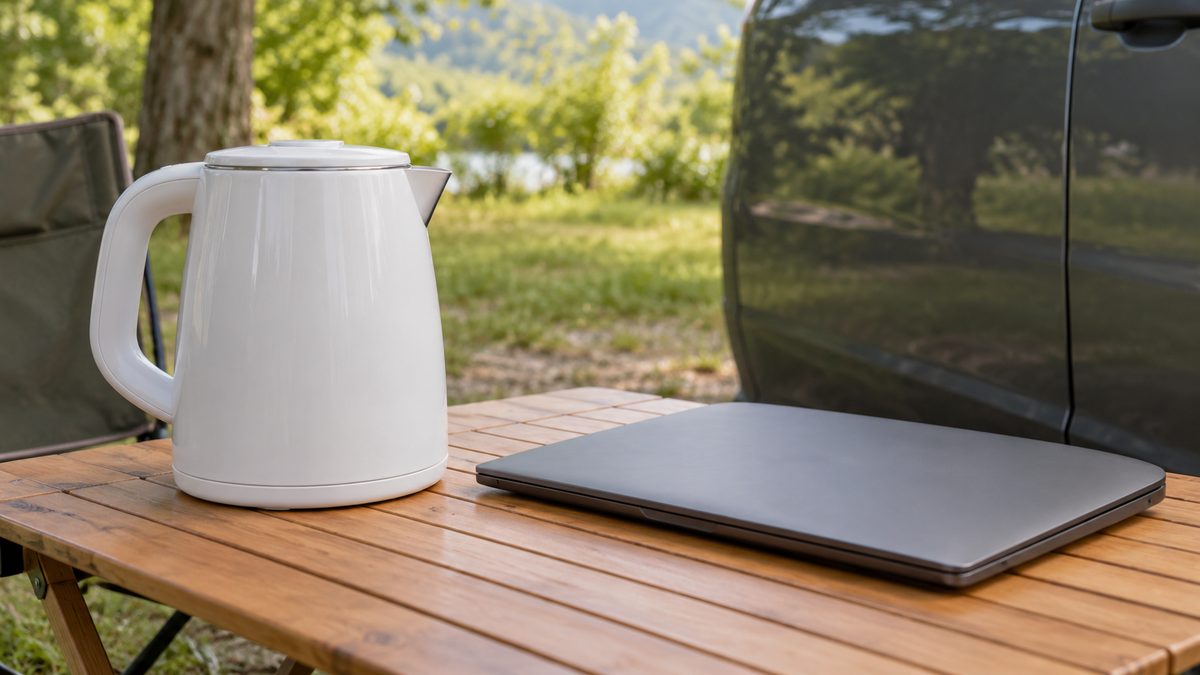
No. A 200W car inverter cannot run an ordinary household kettle, hair dryer or iron. Their heating elements need far more power than this inverter can supply. Plugging one in briefly, using less water or choosing a different AC outlet does not solve the mismatch.
A small inverter suits selected chargers and other modest loads within the vehicle socket limit. Heating appliances belong in a different power category. Before packing for a road trip, read the input label on every appliance you expect to use. The shape of the plug says nothing about its demand.
Compare typical wattages
| Device | Typical rated power | Suitable for a 200W inverter? |
|---|---|---|
| Household electric kettle | Typically about 1,000–2,000W. | No. |
| Household hair dryer | Typically about 800–2,000W. | No. |
| Clothes iron | Typically about 1,000W or more. | No. |
| Everyday laptop charger | Typically about 45–90W; larger models vary. | Potentially, within all supply limits. |
These are planning ranges, not specifications for every model. Some appliances exceed them. Philips lists a 1,000W hair dryer, illustrating how even a modest household dryer can exceed 200W by a wide margin. Your own appliance label and instructions decide its requirements.
For a laptop, distinguish the charger’s input requirement from the output delivered to the computer. The charger and inverter both have conversion losses. Leave capacity rather than aiming at a socket ceiling. Gaming laptops and workstations can fall outside the everyday-laptop range, so check their adapters individually.
Why a shorter run does not fix it
Wattage describes power at a moment in time. Running a high-power heater for fewer minutes changes the energy used, but the supply still has to deliver the power while the heater is on. Filling a kettle with one cup therefore does not turn it into a low-wattage appliance.
A hair dryer’s switches change its operation, but a lower setting is not evidence of a safe load. An iron may cycle its heater off after reaching temperature; the supply still has to support the heating period. Do not rely on cycling, short bursts or a travel label to make an unsuitable appliance work.
Overload protection is intended to respond to a fault or excessive demand. It is not permission to experiment with appliances known to exceed the rating. If an unsuitable load has caused shutdown, disconnect it and follow the inverter instructions. Stop using equipment that is damaged, discoloured or smells burnt.
The car socket adds another limit
EchoRepel’s inverter is rated up to 200W and supports compatible 12V car and 24V truck supplies. A vehicle accessory socket may allow less than the inverter’s full rating. The usable load must stay within both limits, with room for conversion losses. Read the vehicle manual for that particular socket.
At 12V, even a hypothetical 200W input requires roughly 17A before accounting for output losses. That arithmetic explains why a small dashboard socket cannot be treated like a household wall outlet. It does not replace the carmaker’s specified limit or approve a particular installation.
Never fit a higher-rated fuse to accommodate an appliance. Do not bypass the socket, improvise battery wiring or add an extension lead to hide a poor connection. A larger inverter would need a separately designed, suitably installed supply and a vehicle assessment. It is not a direct replacement for a socket-powered unit.
The guide to device wattages in a car helps with smaller loads. Read choosing an inverter size before changing equipment, particularly when several chargers will operate together.
Check 12V travel kettles separately
Purpose-built 12V travel kettles exist. They are different appliances from ordinary AC household kettles and are designed for a compatible DC supply. Their current draw can still be substantial for a vehicle socket. Check the stated voltage, current, plug type and the vehicle’s socket limit before connecting one.
Follow the travel kettle’s instructions for placement and use. Keep hot water away from passengers, electrical connections and controls. Do not operate it while handling the vehicle or balance it on a moving car’s seat. If the requirements are unclear, ask the manufacturer and the vehicle service centre before use.
Pack around the task you need done
For tea on a journey, a properly closed flask filled before departure avoids an electrical heating setup. Use a safe stop for refilling. For clothes and hair care, plan around accommodation with suitable mains outlets rather than trying to power household heating tools from the dashboard.
EchoRepel provides two AC outlets, 30W USB-C PD and QC3.0 USB-A for compatible loads. All share the total rating; two sockets do not double it. Test intended chargers before the trip, keep ventilation clear and unplug when finished. For longer sessions, follow the guidance to run the engine only in a ventilated outdoor area.