How EchoRepel works, and where it helps most
Rats and mice cause the same two problems almost everywhere: they chew wiring, and they contaminate the places where you keep food. A car parked overnight and a quiet storeroom attract them for the same reasons. Both are warm, dark and rarely disturbed. EchoRepel is one small device built to make those spaces unpleasant enough that rodents move on. Below is how it works, how to set it up, and the limits you should know about before you buy anything like it.
Why rodents chew cars and homes
A rat’s front teeth grow throughout its life, several centimetres a year, so it gnaws constantly to keep them short. Soft materials win: cable insulation, plastic pipes, rubber hoses, wood. Many newer cars add a second pull. Carmakers have moved some wiring insulation to plant-based compounds, and owners and mechanics in several countries report more chewing on those vehicles.
Cars get hit hardest when they sit still. After a drive, the engine bay stays warm for hours. Leave the car for a night or a week and you’ve offered shelter with no disturbance. A single bite through a sensor wire can set off warning lights that take a workshop hours to trace, and a damaged wiring harness is one of the more expensive repairs a car can need. We’ve collected repair costs and warning signs in our guide to rats chewing car wires.
Homes follow the same pattern. Rats travel along pipes and cable runs, nest behind fridges and inside false ceilings, and come out at night when the house goes quiet. That’s why the first sign is often scratching above the ceiling around 2 a.m.
What the device does
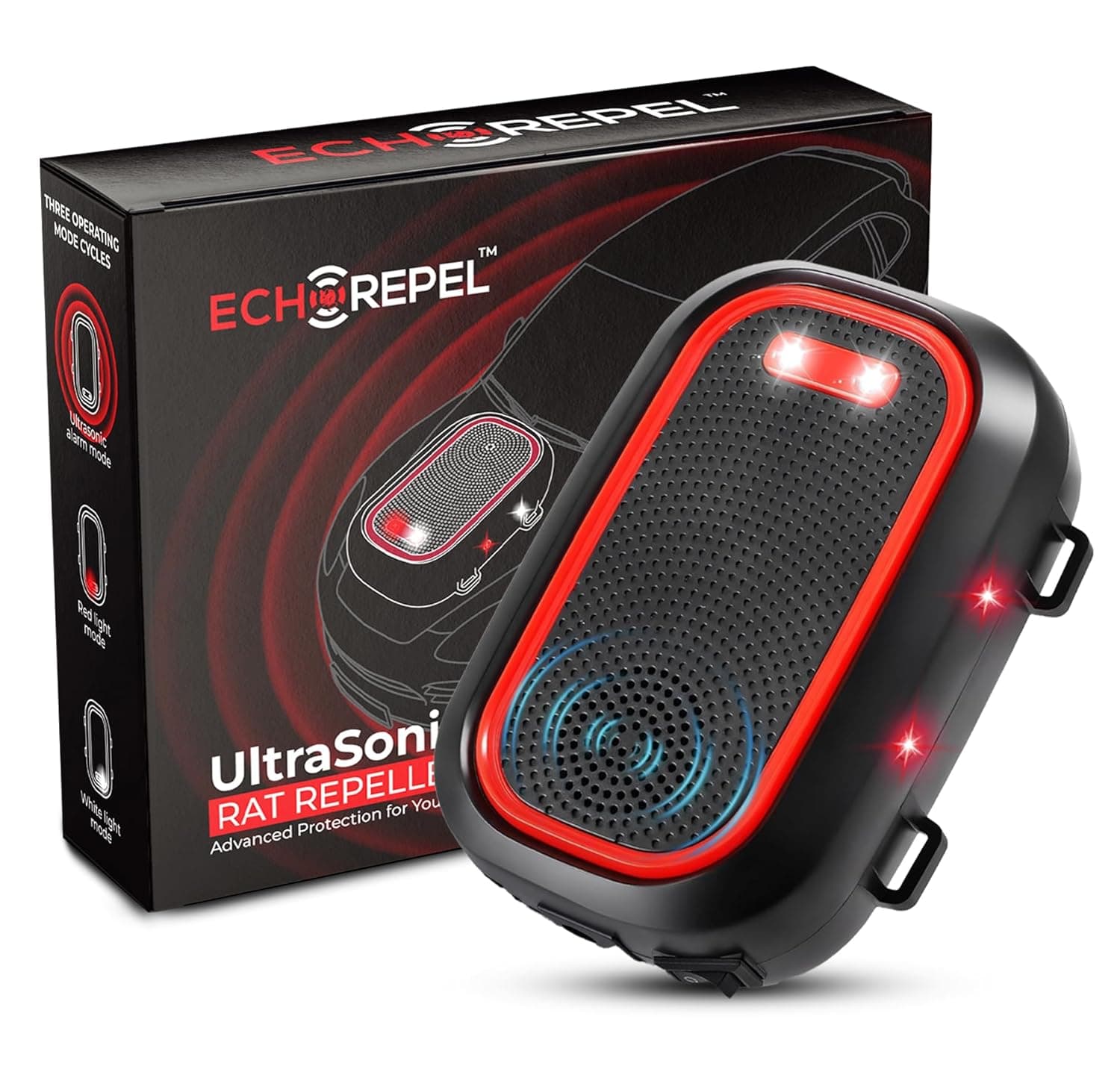
EchoRepel combines two signals. The first is ultrasound that keeps changing pitch across 8 to 56 kHz. Rodents can get used to a single fixed tone, much as you stop hearing a ceiling fan. A sweep that never settles is harder to tune out. The second is a red and white LED strobe, which adds sudden light to dark routes like an engine bay.
| Specification | EchoRepel |
|---|---|
| Ultrasonic output | Variable, 8–56 kHz |
| Light | Red and white LED strobe |
| Power | Vehicle 12–24V, USB/DC 5–12V, or 4 × AA batteries |
| Current draw | 10–13 mA |
| Operating temperature | −25 °C to 65 °C (−13 °F to 149 °F) |
| Coverage | About 40 m² (roughly 430 sq ft) of open space |
| Mounting | Two fastening straps included |
What to expect from any ultrasonic repeller
You should know this before buying any brand. Independent studies of ultrasonic repellers give mixed results. Rats often avoid the sound at first, and the effect fades when the tone never changes or when food is easy to reach. That matches what we see. The device works as one layer of protection, and it works best when you also take away the reasons rodents came in the first place.
- Sound needs open air. Ultrasound bounces off hard surfaces and doesn’t pass through walls, doors, sofas or boxes. Point the unit at the open space you want to protect.
- Give it a week or two. Rodents that already live in a space take time to change their routes. New arrivals tend to turn away sooner.
- Pair it with the basics. Seal gaps wider than about 2 cm (a little under an inch), store food in hard containers, and clear clutter where they nest.
- A heavy infestation needs a professional. If you see rats in daylight or find several nests, call pest control first and use the device afterwards to keep them from returning.
Setting it up in a car
Open the bonnet and pick a flat, secure spot away from the exhaust manifold, belts, fan and radiator. Strap the unit down with the speaker grille facing open space rather than a panel. You can wire it to the car’s 12V supply, run it from USB, or use AA batteries. Battery mode suits cars parked for long stretches, or anyone who would rather not touch the wiring.
Two cautions. In electric and hybrid cars, never connect anything to the high-voltage system (the orange cables). Use the unit’s own batteries or USB power, mounted clear of the battery pack. In cars with a CNG or LPG kit, keep it well away from the gas lines and regulator. Our guides by car model cover where rats get in on specific cars, including CNG and electric versions.
Setting it up at home
Indoors, rodents move along walls, so mount the unit low, about 20 to 30 cm (8 to 12 inches) above the floor, facing the room rather than a wall. Kitchens, storerooms, utility areas and the space under a false-ceiling access panel are the usual spots. Keep it away from curtains and soft furnishings, which absorb ultrasound. The home setup guide walks through placement room by room.
The 200W pure sine wave inverter
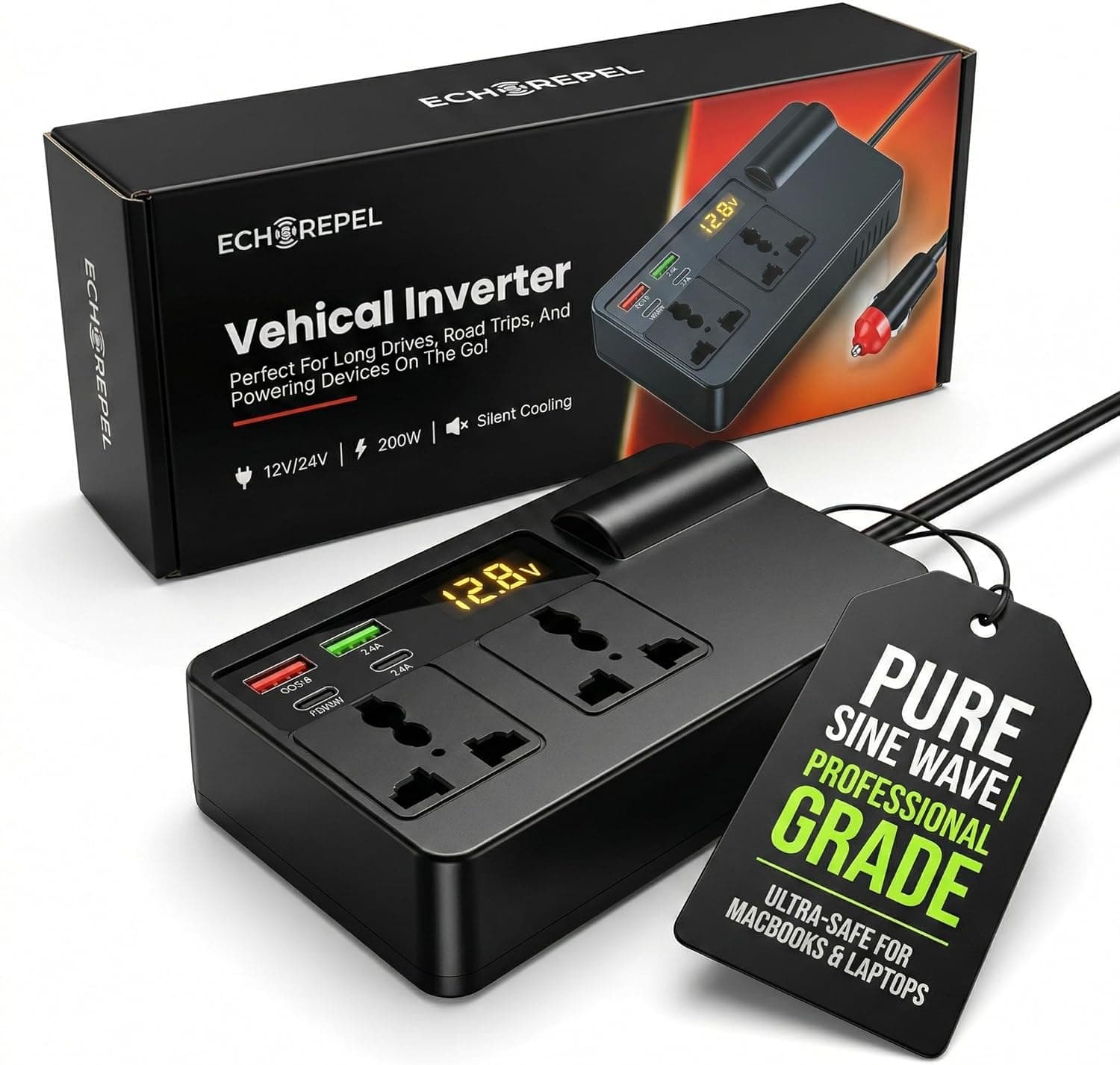
We also make a car inverter. It turns a 12V car or 24V truck socket into mains-style AC power for laptops, cameras and chargers. It has two AC outlets, a 30W USB-C Power Delivery port, a QC3.0 USB-A port and a display that shows your battery voltage. Pure sine wave output matters for laptops and camera chargers, which can buzz or run hot on cheaper modified sine wave inverters.
One limit catches people out. Many car accessory sockets are fused at around 10 to 15 amps, which works out to roughly 120 to 180 watts at 12V. The safe load is whichever is lower: the inverter’s 200W rating or your socket’s fuse. Check your car’s manual. Details and examples are in our car inverter buying guide.
Who we are
EchoRepel is run by a small team in Thane, Maharashtra. We sell directly, so you deal with the people who stock and ship the product. Both devices carry a 12-month warranty against manufacturing defects. If an order arrives damaged, defective or wrong, tell us within 7 days of delivery and we’ll replace it. We deliver across India and offer cash on delivery. The full terms are on our refund and replacement policy page, and you can reach us through the contact page.
The EchoRepel guides are free to read wherever you live. They cover finding a rat nest, cleaning up safely, what smells do and don’t keep rodents away, and how to protect a car you’re leaving parked.