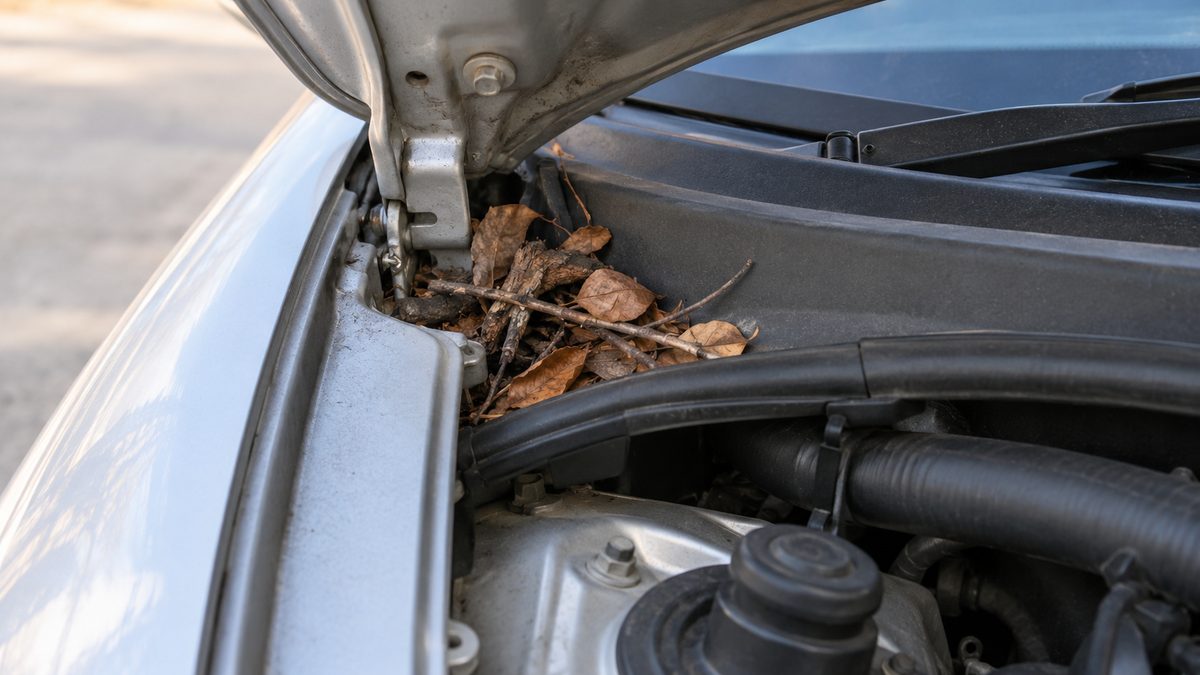
If you live in Phoenix, Tucson, Las Vegas, Albuquerque or the foothills of California and Colorado, you may have opened the hood to find something strange: a heap of twigs, juniper, prickly pear pieces, pebbles and maybe a bottle cap, stacked on top of the engine. That’s the work of a pack rat, and it can happen in a single night.
Meet the pack rat
Pack rats, also called woodrats or trade rats, are native rodents of North America in the genus Neotoma. They’re about the size of a common rat but with a furry tail, large ears and soft fur. Their habit sets them apart: they collect material and build big nests, sometimes called middens, out of sticks, cactus, bones and anything small and shiny they find.
In the wild they build in rock crevices, under shrubs and in brush piles. To a pack rat, the engine bay of a parked car looks like a perfect crevice: dark, enclosed, warm after a drive and hard for predators to reach.
Where they cause the most trouble
- The desert Southwest: Arizona, Nevada, New Mexico, southern Utah and Southern California.
- Foothill and mountain towns in Colorado, Texas and the Intermountain West.
- Homes on the edge of open desert or brush, especially with cars parked outside.
- Cars that sit for days: second vehicles, RVs, cars of winter visitors.
Signs of pack rats in your car
- A pile of debris on the engine, battery or in the cowl area below the windshield.
- Collected objects such as pebbles, foil, bottle caps or cactus pads mixed into the pile.
- Chewed wires and hoses, often near the nest.
- A strong urine smell and dark stains where they mark their territory.
- Debris on the ground under the car in the morning.
- Warning lights or a car that won’t start after sitting.
The damage they do
Pack rats chew while they build. Wiring, vacuum lines, coolant hoses and the insulation pad under the hood are common targets. The nest itself causes problems too. Packed into the air intake, it chokes the engine. Stuffed near the exhaust manifold, dry sticks and leaves become a fire risk once the engine gets hot. If you find a nest, clear it before you start the car.
The bill can be high. Modern cars run sensors and electronics through long wiring harnesses, and tracing a chewed wire takes a workshop time. If you have comprehensive cover, check whether it pays for animal damage; our guide to car insurance and rodent damage explains what to look for.
Clearing a pack rat nest safely
- Wear gloves and a mask. In parts of the Southwest, woodrat nests can harbour fleas that carry plague, which is rare but present. Health departments advise against handling nests bare-handed.
- Wet the material first with disinfectant or a dilute bleach solution, then remove it by hand into a bag. Don’t blow it out with compressed air.
- Wash away the urine scent with an enzyme cleaner made for animal urine. Pack rats mark their sites, and the smell invites the next one in.
- Inspect wiring and hoses, or have a mechanic do it if anything looks chewed.
Keeping pack rats out
- Clear the brush. Remove woodpiles, prickly pear, dense shrubs and junk piles near where you park. Pack rats rarely travel far from cover.
- Light the engine bay. Many Southwest residents leave a work light or LED strip under the open hood at night. Pack rats are nocturnal and avoid lit, exposed spaces.
- Leave the hood up in a closed garage, so the engine bay stops feeling like a crevice.
- Drive often. A car moved every day is a poor place to build.
- Seal the garage. Fix gaps under the door and around pipes; woodrats fit through openings about the width of a quarter.
- Trap where it’s legal. Live traps or snap traps set along the route from the brush to the car work well. Check state wildlife rules first, since a few woodrat species are protected.
- Add a deterrent that runs on its own. A battery-powered ultrasonic unit with an LED strobe adds sound and light to the engine bay through the night. It works best combined with clearing brush and removing old nest scent.
Pack rats are only one of several animals that target parked cars. For the smaller visitors, read mice in your car engine, and for the general warning signs, see signs of rodents in your car.