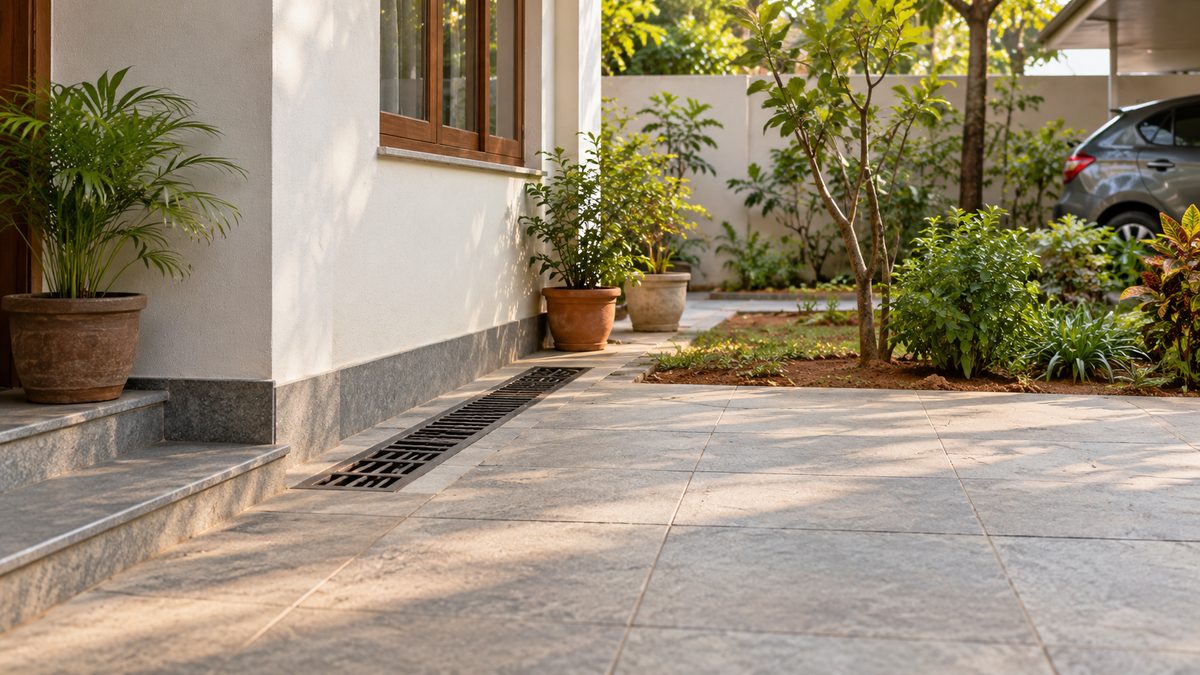
A heavy-bodied rat disappearing beside a ground-floor drain can look startlingly big. In many Indian neighbourhoods, bandicoot rats are among the possible culprits. They are burrowing rats found around cities and farmland. The useful response is to inspect where they travel, what they eat and whether their digging is affecting the property.
Why bandicoot rats look so large
Bandicoot rats belong to the genus Bandicota. India has greater and lesser bandicoot rats, so the common name covers more than one species. Some can look much larger than a house rat, with a stockier build. They are naturally substantial rodents; a large individual is not evidence of a mutation or an unusual new pest.
Age, species, posture and viewing distance affect apparent size. A rat seen beside a narrow drain can seem enormous without providing a reliable measurement. Avoid trying to catch or approach it for scale. A photograph taken from a safe distance and a record of nearby burrows are more useful for identification.
The research review Rodent Control in India, hosted by the Natural Resources Institute, describes bandicoot rats in agricultural and urban settings. Its account connects rodent problems with food access, building maintenance and rodent proofing. Those practical conditions matter more to prevention than guessing an animal’s weight.
Look for burrows as well as the animal
Check from a safe position for openings at ground level, displaced soil, repeated movement along walls and activity near drains. Bandicoots make burrows, which can extend beyond the visible entrance. Do not reach into a hole or assume an apparently quiet opening is empty. Other animals and drainage defects can leave holes too.
House rats commonly use climbing routes, roof spaces and higher service openings. That distinction helps direct an inspection, but it is not absolute: rats can use several routes. Our guide to telling rats and mice apart gives further context when the animal was only briefly visible.
| Clue | What it may suggest | What to check next |
|---|---|---|
| Stocky rat near soil or a drain | Possible bandicoot activity | Nearby burrows and food sources |
| Rat using pipes or roof spaces | Possible house-rat climbing route | Upper service gaps and roof access |
| Fresh soil beside paving | Recent digging | Movement, settling and adjacent services |
| Repeated signs by a broken drain | A shared access route | Drain condition and cover fit |
| Sinking paving or cracks | Potential void or structural problem | Professional building assessment |
Take digging beside buildings seriously
Burrows can remove supporting soil beneath floor edges, paving and drains. Damage depends on the tunnels and the construction; a single hole does not prove foundation failure. Fresh sinking, loose slabs, a leaking drain or cracks beside repeated digging need attention from the society manager or property owner.
Keep children and pets away from suspect ground. Ask pest professionals to assess activity and a suitable building or drainage contractor to inspect damage. Do not dig alongside foundations, break open paving or fill a void blindly. Repairs need to address the tunnel, access route and any damaged service in a coordinated way.
Seal ground-level entries and repair drain access
Inspect the bottom of doors, pipe penetrations, broken air bricks and wall-to-floor junctions. Use durable, rodent-resistant repairs suited to each opening, such as properly fitted metal barriers or sound masonry. Expanding foam alone is a poor barrier to gnawing. Before sealing, arrange an inspection so animals are not trapped inside occupied rooms or hidden cavities.
Have loose or broken drain covers replaced with securely fitted, load-appropriate covers. Drain guards must preserve flow and allow maintenance; a blocked outlet can create another problem during rain. Read about rats using toilets and drains when activity seems connected to plumbing. Never enter a manhole or drain to investigate.
Remove the food supply across the compound
Use bins with close-fitting lids and arrange regular rubbish removal. Wash away food spills around collection points and keep waste away from entrances. Bring pet bowls inside after feeding. Do not leave rice, roti, grain or other food outdoors overnight, including on a utility balcony close to ground-level routes.
Inside, store grains and snacks in sturdy closed containers, clear food from under appliances and reduce clutter beside walls. In a society compound, involve neighbouring residents and maintenance staff. One clean kitchen cannot remove the attraction of an overflowing communal bin or a damaged shared drain immediately outside it.
Use deterrents as a supporting measure
EchoRepel’s home repellent can be placed in a suitable dry problem area with its grille facing an open route. Walls, closed cupboards and tightly stacked items block or reduce ultrasonic sound. It cannot reach underground burrows or repair an entry hole, so keep sealing, food control and professional management central to the plan.
Record fresh activity and review the same locations after repairs and rubbish collection. If holes reopen or paving continues to move, return to the professionals rather than adding chemicals to the burrows. A workable prevention plan should reduce access and food while keeping the building and drainage system sound.