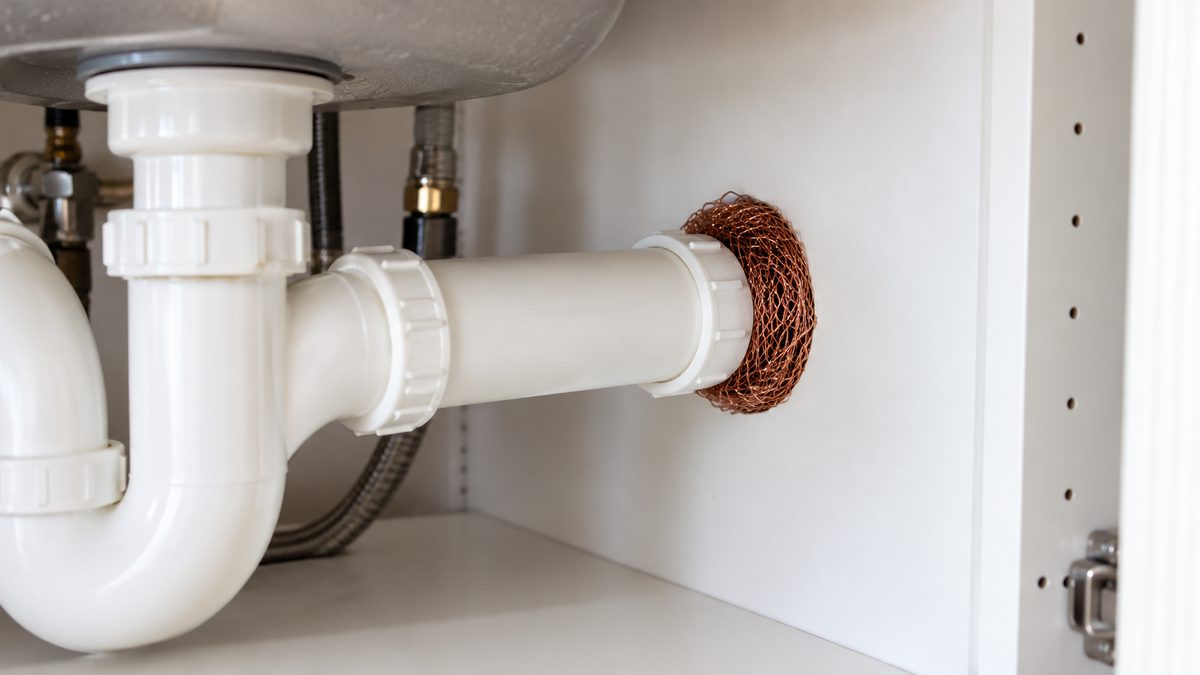
Copper mesh is a flexible bundle of fine metal strands used to fill small, irregular openings. It can help stop mice using the space around a pipe or service sleeve. During fall (autumn), those gaps deserve attention before you close cabinets and pack storage against the wall for winter.
The repair works through a physical barrier. Copper mesh does not repel mice by smell, and it does not remove animals already indoors. Its usefulness depends on how tightly it fits, how it is retained and whether the wall around it is sound. Treat it as one material in an exclusion kit.
Why copper mesh can work
Mice have difficulty chewing through a dense tangle of metal strands. That makes properly packed mesh more resistant than a soft filler alone. It can also conform around a pipe where cutting a rigid plate would be awkward. A shallow tuft resting over the opening offers much less resistance.
Copper does not rust like ordinary steel wool. It can tarnish, and long-term durability still depends on moisture, contact with other materials and the installation. Buy mesh sold for rodent exclusion, checking the stated composition. A copper-colored household scrubber is not automatically equivalent to a purpose-made exclusion material.
Metal filling does not protect rotten wood or crumbling mortar around it. Mice may enlarge that weaker edge or use a different gap nearby. Our guide to materials rats can chew through explains why a repair needs a durable surrounding surface too; the article covers rats, so do not transfer its gap sizes to mice.
Choose the material before starting
| Gap type | Best material |
|---|---|
| Small irregular gap around a cool pipe | Tightly packed copper mesh with compatible sealant |
| Small dry interior opening | Secured steel wool or copper exclusion mesh with sealant |
| Larger hole in a sound surface | Mechanically fixed metal plate or suitable hardware cloth |
| Cracked or missing masonry | Appropriate masonry repair, with metal reinforcement where needed |
| Gap beneath a door | Durable door sweep and sound threshold |
| Ventilation opening | Application-approved guard that preserves required airflow |
For a wider opening, choose hardware cloth with openings no larger than about 1/4 inch [0.6 cm], and fix its edges securely. A large hole loosely stuffed with mesh is vulnerable to movement. There is no universal maximum gap for every mesh product: follow its installation instructions and use a rigid repair when support is poor.
Prepare the gap and tools
Wear work gloves because cut strands can scratch or puncture skin. Gather the mesh, suitable cutters, a blunt packing tool and compatible sealant. Read the sealant instructions for surface preparation, temperature, depth and curing time. Exterior exposure, damp masonry and moving pipe joints may need different products.
Inspect first for damaged wiring, hot equipment, water leaks and signs of rodents. Do not push your fingers into an unseen cavity. Repair the leak or damaged building material before sealing. If droppings are present, follow safe cleanup guidance rather than dry brushing them into the room.
Pack, retain and inspect
- Prepare the sound edges. Remove loose debris without damaging the pipe or sleeve. Follow the sealant maker's cleaning requirements.
- Cut a generous piece. Shape the mesh to fit the entire gap, keeping it clear of the working pipe opening.
- Pack it firmly. Use a blunt tool to fill the space around the pipe, including the underside. Avoid a thin surface plug.
- Secure the filling. Apply compatible sealant according to its instructions so the mesh cannot readily be pulled out.
- Check after curing. Look around the full perimeter for open edges, looseness or remaining access.
Photograph the finished repair so you can compare it later. Revisit it after service work or evidence of renewed gnawing. Do not assume the first gap you find is the only route. The CDC sealing guide identifies indoor and outdoor places worth inspecting.
Check the back of the opening when it is safely accessible. A neat bead on the room side can conceal an unfilled route behind the cabinet. If you cannot inspect or retain the filling properly, ask a professional to fit a more durable repair. Keep a note of the materials used for future maintenance.
Where copper mesh should not go
Never stuff it into a dryer exhaust, drain, air brick or combustion-air opening. Those routes have a function that must remain clear. Around a flue or hot pipe, use an appropriate rated repair installed to the equipment requirements. Ordinary mesh and household sealant are not a substitute for a firestop system.
Copper conducts electricity. Keep it away from electrical terminals, damaged cables and exposed wiring. Ask an electrician about those penetrations. For moving doors, use a sweep; for structural damage, repair the structure. These choices prevent a small exclusion job from creating a maintenance problem.
Finish the rest of the prevention work
Secure food, clear nesting clutter and check garage seals while making repairs. Follow the whole-house mouse prevention checklist to cover the surrounding rooms and yard. Mice already inside need removal as well as exclusion. Ultrasonic repellents are a supporting measure only: results vary, and sound does not pass through walls.