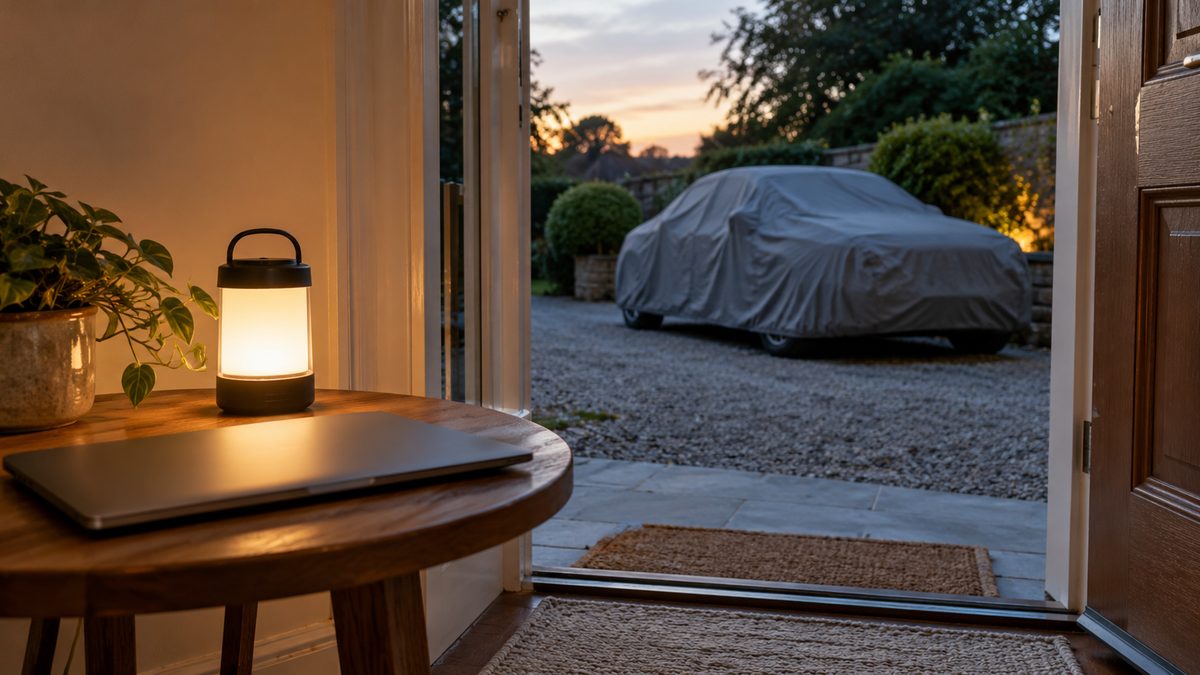
When the lights go out, the car sitting in your driveway is, in effect, a large battery on wheels. With the right inverter you can put it to work keeping the essentials running, as long as you understand what is realistic and what is not.
What a car can power
- Phones and power banks: keep everyone connected.
- A laptop: work through the outage; most use 45–90W.
- A Wi-Fi router or dongle: internet stays up.
- LED lights and a small fan: comfort during the wait.
What it cannot power
A compact inverter will not run a fridge, air-conditioner, geyser or induction stove. Those draw far more power, and appliances with motors or compressors spike even higher at startup. (See can you run a fridge on a car inverter.)
How to do it safely
- Use a pure sine wave inverter, clean power that will not harm laptops or routers.
- Keep the total load under the inverter's rating.
- On longer outages, start the engine periodically so you do not flatten the battery.
How much can you run at the same time?
Add up what you want to run together. Typical draws for outage essentials look like this:
| Device | Typical draw |
|---|---|
| Wi-Fi router | 8–15W |
| Phone charging | 5–20W each |
| LED bulb or strip | 5–12W |
| Small table fan | 20–40W |
| Laptop | 45–90W |
A router, two phones, an LED light and a laptop together come to roughly 100–150W, comfortably inside a 200W inverter. A fridge, mixer, iron or kettle is a different league: hundreds to thousands of watts. For a fuller list, see how many watts it takes to run devices in a car.
How long will the battery last?
A typical Indian hatchback or sedan battery stores around 35–45 Ah at 12V, very roughly 400–550 watt-hours on paper. You should never drain a car battery fully, though: going below about half charge makes starting unreliable and shortens battery life. So with the engine off, plan on using only a small part of that.
- Small loads (router, phones, a light, about 30W): a few hours with the engine off is usually fine on a healthy battery.
- Bigger loads (laptop plus fan, about 100W+): start the engine and let it idle for 10–15 minutes every hour or so.
- Old or weak battery: keep engine-off use short, because it has far less capacity than its label says.
The safest habit is to watch your battery voltage. A healthy 12V car battery at rest reads about 12.6V; if it drops towards 12.0V, start the engine. More detail in how long a car battery lasts when parked.
A critical safety rule: never idle in a closed space
If you run the engine to recharge the battery, the car must be in the open, never in a closed garage, a basement with poor airflow, or a covered spot next to an open window. Exhaust contains carbon monoxide, which you can't see or smell. Park outside, keep the exhaust pointing away from the house, and run cables in through a door, not the other way round.
Setting it up step by step
- Park the car where it's safe to idle, close to a door.
- Plug the inverter into the 12V socket and switch the ignition to accessory mode (or start the engine).
- Run a good-quality extension cord indoors, keep it off wet floors.
- Connect the router first, then phones and lights; add the laptop last.
- Check the battery voltage every hour; idle the engine when it dips.
- Unplug everything and switch the inverter off before you leave the car.
A small power-cut kit worth keeping in the car
- A pure sine wave inverter that fits your 12V socket.
- A 5–10 m extension cord with a surge-protected strip.
- A rechargeable LED lamp and a couple of USB cables.
- A torch, in case the outage happens after dark.
None of this replaces a home inverter or generator for long outages, but for the common few-hour power cut it keeps you connected, lit and working, with equipment you already own.
The EchoRepel 200W Pure Sine Wave Inverter plugs into your 12V socket and gives you clean, reliable power for the essentials, a simple bit of insurance for the next time the grid goes quiet.