It is one of the most common questions people ask before buying a car inverter, so let us answer it plainly: a 200W inverter will not run a normal fridge. That does not make it useless. It runs most of the electronics people carry on the road, and there are simpler ways to keep food cold on a trip.
Why a fridge is off the table
A fridge might only draw 100–150W while running, which sounds within reach. The problem is the startup surge: when the compressor kicks in, it briefly pulls three to five times that, often 600W or more. A 200W inverter cannot supply that spike, so the fridge either will not start or the inverter shuts down to protect itself. Even if it could start, a household fridge cycles on and off all day, and every start is another surge.
Your car's socket sets a limit too
A plug-in inverter is also limited by the socket it plugs into. Most 12V sockets are protected by a 10 to 15 amp fuse, which works out to roughly 120 to 180 watts at the input, and the inverter loses a little in conversion. So the practical budget is lower than the number on the box. Our guide to the cigarette lighter power inverter explains how to check your own car's fuse rating in the manual.
What a 200W inverter does run well
| Device | Typical power (check your label) | Fits on a 200W inverter? |
|---|---|---|
| Laptop | 45–90W charger | Yes, one at a time is easy |
| Phone charger | Usually under 30W | Yes, several |
| Camera battery charger | A few watts to about 15W | Yes |
| Wi-Fi router or dongle | Usually under 20W | Yes |
| Small USB or desk fan | Usually under 15W | Yes |
| LED lights | Usually under 20W | Yes |
| Household fridge, kettle, iron, hair dryer | Hundreds to thousands of watts | No |
The rule is simple: add up the wattage of what you want to plug in and keep the total comfortably under both the inverter's rating and your socket's limit. Our inverter size guide walks through the sum with a laptop example.
Better ways to keep food cold on a trip
If cold drinks and food are the goal, an inverter is the wrong tool. Two options work better:
- A cool box made for 12V car power. It plugs straight into the car socket, so there is no inverter and no conversion loss. Compressor models cool properly; cheaper thermoelectric ones only keep things a certain amount below the outside temperature. Check the power rating against your socket fuse.
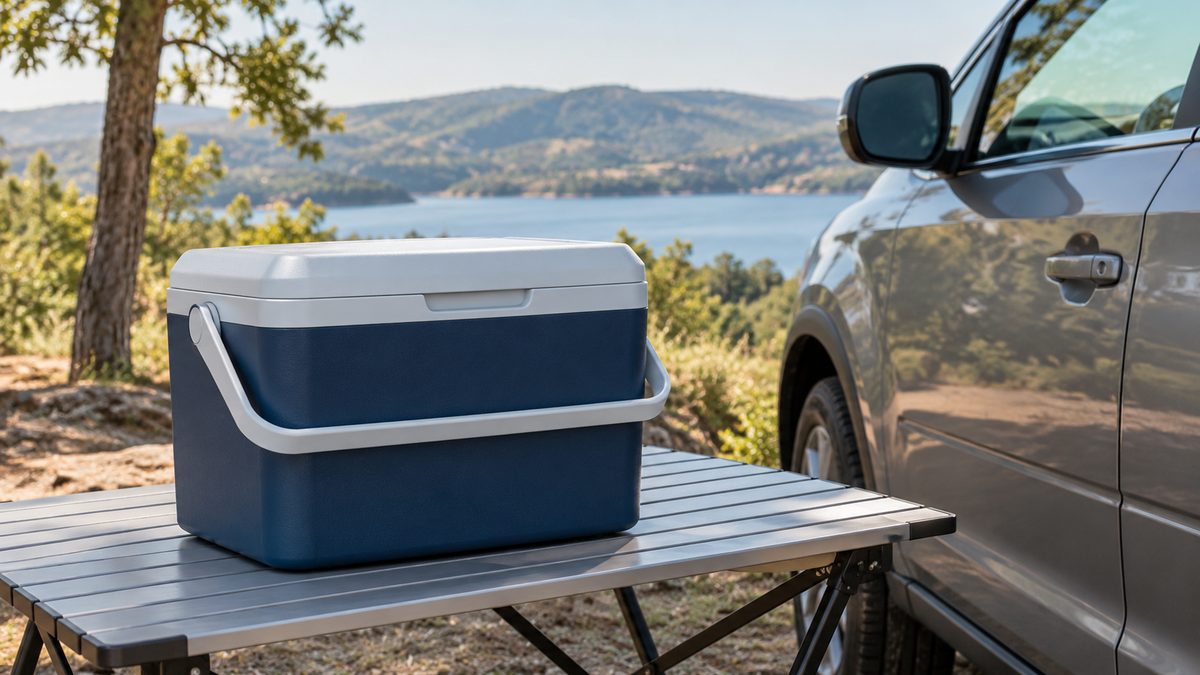
- A good insulated ice box. No power at all, and on a one-day drive it is often enough.
Engine on or off?
Anything plugged into the socket draws from the car battery. With the engine running, the alternator keeps up. With the engine off, even a laptop can run a battery down over a few hours, and a car that will not start is a bigger problem than a flat laptop. If you work from a parked car, start the engine now and then, and read whether it is safe to leave an inverter plugged in.
When you really do need fridge power
Running a full fridge from a vehicle needs a large inverter, usually 600 to 1000W or more, wired directly to a battery with heavy cables, and a battery bank that can sustain the load. Many people choose a portable power station instead. Either way, it is a different product from a compact inverter that plugs into the dashboard.
Why pure sine wave matters
Cheaper inverters output "modified" sine wave power, which can make sensitive electronics buzz, run hot, or fail over time. A pure sine wave inverter delivers clean power like a wall socket, safe for laptops and cameras.
If your need is powering electronics on the go, not running a kitchen, the EchoRepel 200W Pure Sine Wave Inverter plugs into your car's 12V socket and gives you clean power for the devices most people carry.