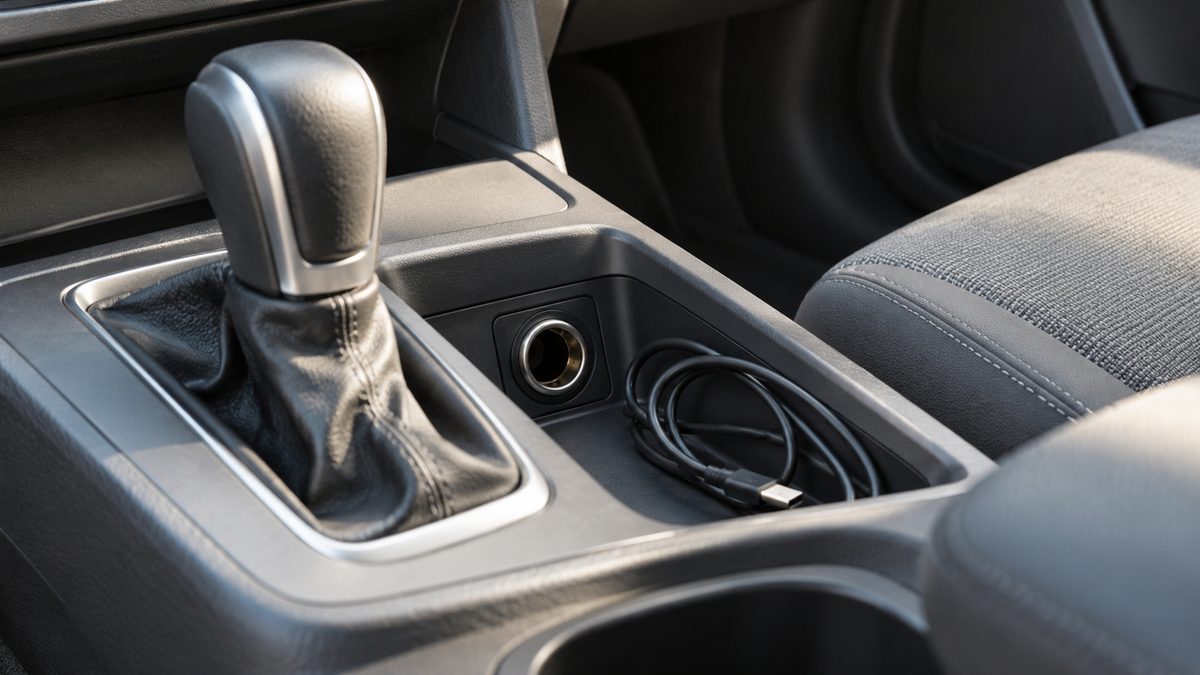
A cigarette lighter power inverter can supply an AC charger from a car’s accessory socket, but the socket is a small power source. Buying an inverter with a bigger number on its case does not upgrade the wiring behind the dashboard. Start with the vehicle manual, then check the inverter and charger.
The term cigarette lighter socket is still common even when a car has no lighter fitted. A similar-looking accessory outlet may have a different rating or operating schedule. Read the markings and the instructions for that exact outlet, including any limits shared with other sockets.
What 10 to 15 amps means
Most 12V sockets are fused around 10 to 15 amps, giving roughly 120 to 180 watts at a nominal 12V. Check your owner’s manual and fuse. Multiply volts by amps to understand the scale, but use the manufacturer’s stated accessory rating to decide what is permitted.
That calculation describes DC input power. An inverter uses some energy in its electronics and cooling, so its available AC output is lower. A circuit nominally capable of supplying 120W cannot continuously deliver 120W of AC through an inverter without accounting for those losses.
A fuse protects a circuit against excessive current; it is not a target for continuous loading. Plug condition, wiring, shared loads and installation instructions matter too. Do not increase the fuse rating to stop nuisance failures. You could leave the wiring without its intended protection.
Match the load to the connection
Read the charger label before plugging it in. Its output rating gives useful context, but AC input also includes losses. If the label lists only input volts and amps, do not assume their product is an exact measurement of real operating watts. Ask the equipment maker when the margin is tight.
| Equipment | Socket-powered use | Check first |
|---|---|---|
| Phone or tablet | Usually a modest load | Compatible direct USB may be sufficient |
| Camera battery charger | Often practical | AC voltage, frequency and adapter rating |
| Lightweight laptop | Often possible | Charger input plus other connected devices |
| Gaming laptop | May exceed the socket limit | Full charger demand under load |
| Kettle, iron or hair dryer | Unsuitable for ordinary socket inverters | High heating-element demand |
| Compressor appliance | Needs a careful compatibility check | Startup demand as well as running watts |
Use our device wattage guide for car power as a planning aid, then check your own equipment. Two small chargers may fit individually but exceed the safe total together. Include USB output as directed by the inverter’s combined-load instructions.
Why heating appliances are a poor fit
A household kettle or iron turns electricity into a large amount of heat. Its demand is far beyond the charging loads that a normal accessory circuit can handle. A travel-sized case does not guarantee low power, and a plug adapter does not reduce electrical demand.
A purpose-made 12V kettle is a separate device with its own current requirements. It still needs a compatible socket and may take much longer to heat water. The kettle, hair dryer and iron guide explains why a small inverter is unsuitable for these household appliances.
When higher power needs a battery connection
Higher-watt inverters need a direct battery connection when their specified input demand exceeds an accessory socket’s capacity. Choose equipment designed for that installation. Correct cable size, cable length, fuse placement and secure terminals are part of the job, not optional extras.
Do not cut off a socket plug, attach improvised clips or bypass the fuse to chase the printed wattage. Ask a qualified installer to assess the vehicle’s charging system and the inverter instructions. A direct connection also does not make a starting battery suitable for unlimited engine-off use.
Using it with the engine running
For longer charging sessions, follow the vehicle instructions and keep the engine running in an open outdoor location. Exhaust must stay clear of windows, doors and people. Never idle in a garage, even with the door open, and stay with the vehicle and connected equipment.
Switch off the load before starting the engine unless the equipment instructions specify another sequence. Engine-running voltage does not authorize a higher socket load. In hybrids and electric vehicles, follow the manufacturer’s auxiliary-power procedure and leave high-voltage components alone.
Stop when the connection becomes hot
Before a trip, try the intended charging setup while parked safely outdoors. Check it under the workload you expect to use, with every planned charger connected. Keep the manual available so an alarm or a warm connection does not turn into guesswork at a rest stop.
Seat the plug firmly and route cables away from pedals, seat tracks and airbags. Keep the inverter dry with its vents uncovered. An unusually hot plug, burning smell, discoloration or intermittent supply is a reason to disconnect and inspect, even if the fuse has not blown.
After charging, switch off and unplug the inverter. Some sockets remain live with the ignition off. Repeated alarms or shutdowns need diagnosis, not repeated resets. Choosing a smaller load or a compatible USB charger is often the practical answer when the socket cannot support your original plan.