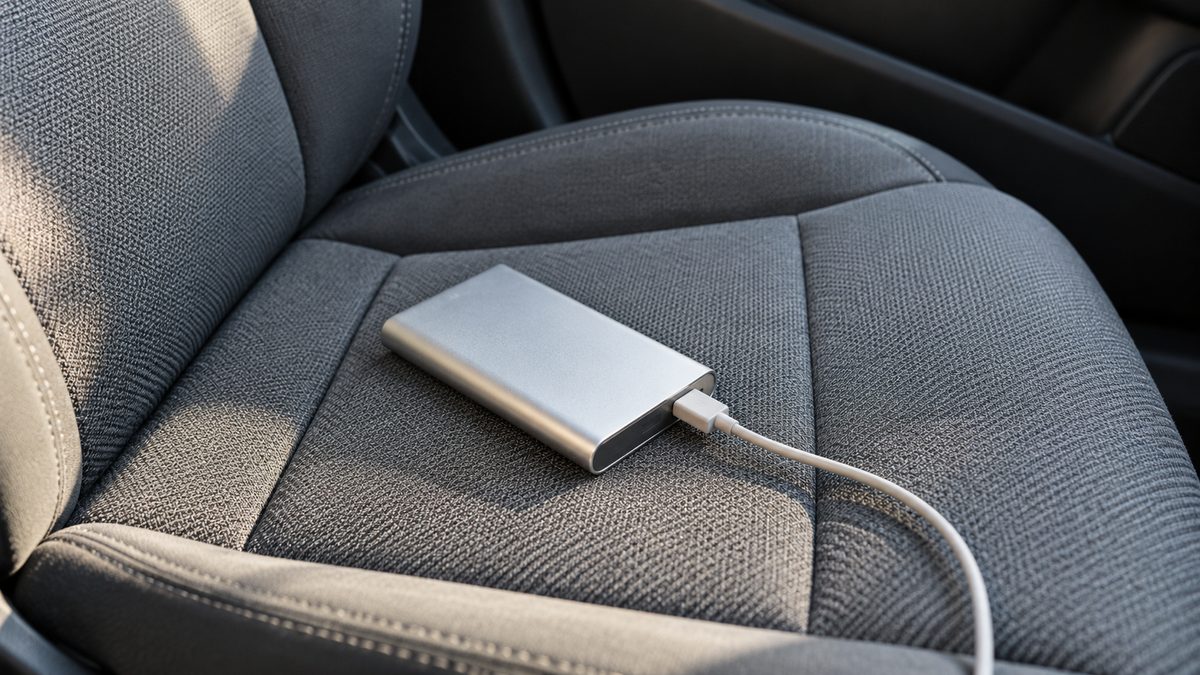
Charge a power bank through a compatible car USB port or a suitable USB car charger, checking the power bank’s input rating. Use an inverter only when you need its wall-charger connection, and keep the equipment cool and secure while travelling.
1. The car's built-in USB port
Most cars now have a USB port on the dashboard or console. It is convenient, but many of these ports were designed for music and data, not fast charging, so they supply little power. That is fine for topping up a phone. A large power bank may take several long drives to fill this way.
2. A 12V USB-C PD car charger
A charger that plugs into the 12V socket is usually the fastest simple option. Look for USB-C Power Delivery (PD) and check that your power bank supports fast input through USB-C. Our guide to USB-C PD vs QC3 car chargers explains what the labels mean. Use a cable rated for the current.
3. A car inverter and the wall charger
A car inverter turns the 12V socket into a household-style plug point. You can then use the power bank's own wall adapter. This is handy if you also need to charge a laptop or run another device, but it is more kit for a single power bank. Some inverters, including ours, also have a USB-C PD port. Read car inverter vs power bank to see which suits your trips.
| Method | Typical speed | Note |
|---|---|---|
| Built-in car USB port | Often slow | Fine for top-ups; check the car manual for its rating |
| 12V USB-C PD charger | Usually fast, if the power bank supports PD input | Simplest for one power bank |
| Car inverter with wall adapter | Depends on the adapter | Useful when you also run a laptop or other plug-in device |
How long it takes, roughly
Two numbers decide the time: how much energy the power bank holds and how many watts it can take in. A 20,000mAh power bank stores roughly 74 watt-hours (20,000mAh at a nominal 3.7V). If it accepts 18W and the charger can supply it, a full charge takes around four to five hours once losses are included. At 30W input it can be quicker. On a port giving 5W, it can take many hours. Treat these as rough figures; the power bank's own label and manual give the real input rating.
Keep it safe
Charge with the engine running, so you are not draining the car battery. Keep the power bank out of direct sun and off the dashboard. Never leave a power bank charging in a parked car, and do not store one in a car parked in the sun for hours. Heat is hard on lithium cells. Stop using any power bank that swells, gets very hot or smells of burning.
If you use an inverter, unplug it when you park. Our guide on leaving a car inverter plugged in explains why.
Which option should you pick?
If you only charge a phone and a power bank, a good USB-C PD car charger is enough. If you work from the car, run a laptop on the road or charge several devices with their own plugs, a car inverter covers more. Either way, a full power bank before you leave home is still the simplest plan.
Check the input port rather than the largest number
A power bank can advertise a high output for charging a laptop while accepting a different maximum input for recharging itself. Look for the input specification beside the intended port or in the manual. A connector's shape alone does not establish its supported charging modes.
Match the car charger, cable and power bank as a system. If one part supports only a lower charging level, buying a larger charger may make no difference. Where a charger has several ports, check how it shares power when more than one device is connected. Start by testing the bank on its own while parked safely.
Make a slow-charge check in a useful order
First confirm that the car socket is powered in the vehicle state you are using. Then check that the cable is fully seated and plugged into an input-capable port on the bank. Try a known-good compatible cable before replacing the charger or assuming the battery is faulty.
Check the charging indicator after an interval, rather than expecting an immediate percentage jump. Charging often slows near full, and heat can also affect operation. Stop if a plug, socket or bank becomes unusually hot. Do not leave the setup running unattended to see whether a fault clears.
Store it for the stop, not on the dashboard
Secure the bank where it cannot slide into a footwell or become trapped in a seat mechanism. Leave airflow around it and avoid covering it with a coat or bag while charging. Arrange the cable so passengers can get out without pulling the device onto the ground.
At your destination, unplug and take the bank with you when the car will become hot. If it is swollen, damaged or smells unusual, stop using it and seek the manufacturer's handling and local disposal guidance. Do not open the case, puncture it or keep charging it because you need power for the return journey.
Frequently asked questions
Does USB-C always mean fast input charging?
No. Check the power bank’s input specification, the charger’s supported modes and the cable. The connector shape alone does not establish the charging rate.
Why does charging slow when I connect another device?
Some multiport chargers share their available power. Check the charger instructions for the combination being used, and test the bank on its own before replacing equipment.
Can I leave the bank inside a closed bag while charging?
Avoid covering it or trapping heat. Follow its instructions, keep it out of direct sun and secure it where cables cannot reach pedals or moving seat mechanisms.
Can I charge a power bank while it charges my phone?
Only if its manual supports that operating mode. It may charge more slowly or become warmer, so separate the tasks when the instructions are unclear.