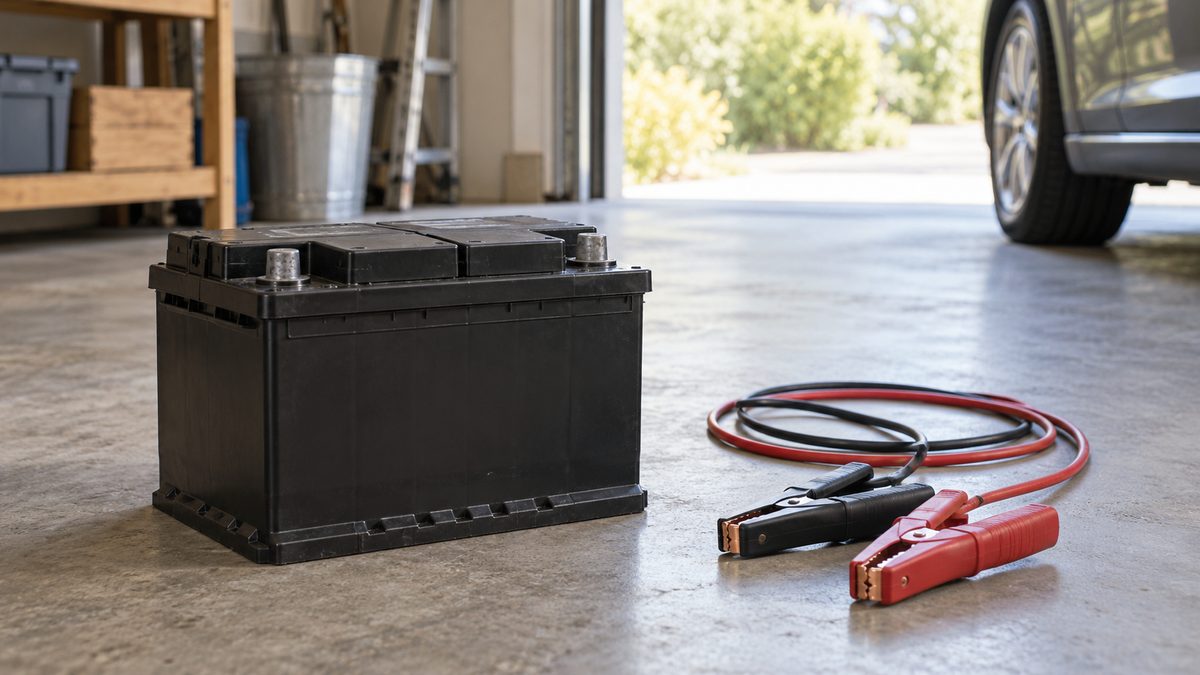
You can charge a suitable car starter battery at home with a compatible charger, using the connection points and procedure specified in both manuals. Do not charge a damaged battery or assume every no-start problem is caused by low charge.
Option 1: drive the car
If the car still starts, the alternator recharges the battery as you drive. A steady run on open road helps more than stop-start traffic. Switch off the AC, rear demister and other heavy loads where it is safe to do so. Short trips of a few minutes often use more charge to start the engine than they put back. Our guide to how long a car battery lasts when parked explains why cars that sit for days struggle.
Option 2: a plug-in battery charger
A plug-in charger connects to the battery terminals and a wall socket. Smart chargers check the battery, charge in stages and drop to a gentle float mode when full, which makes them the easier choice for home use. Pick one that matches your battery type: many modern cars with start-stop use EFB or AGM batteries, which need a charger that supports them.
Option 3: jump start, then drive
Jump leads from another car or a portable jump starter can get the engine running. This does not charge the battery much by itself, so drive for a good while afterwards or follow up with a charger. If the car needs a jump every few days, the battery or the charging system needs checking.
| Method | Rough time | When to use |
|---|---|---|
| Drive the car | Half an hour or more, depending on the drain | Car still starts; slightly weak battery |
| Smart battery charger | Several hours to overnight, depending on charger and battery | Flat battery at home; long parking |
| Jump start, then drive | Minutes to start, then a long drive | Car will not start and you need it now |
| Maintenance charger | Left connected while parked | Car unused for weeks |
Safety first
Lead-acid batteries can give off hydrogen gas while charging. Charge in a well-ventilated place, keep sparks, flames and cigarettes away, and wear eye protection and gloves. Follow the connection order in your car manual and the charger manual. A common order is positive clamp first, then negative to an unpainted metal point on the body or engine, and the reverse when removing. Some cars require the battery to be charged through specific terminals under the bonnet.
Never charge a battery that is swollen, cracked, leaking or frozen. Stop if it becomes hot or smells of rotten eggs. Keep children and pets away from the work area.
Check it after charging
Let the battery rest for a few hours after charging and then test it. Our guide to testing a car battery shows how to read a multimeter. A battery that drops back quickly after a full charge is losing capacity.
When charging will not help
Batteries wear out. If yours keeps going flat, struggles on cool mornings, is several years old or fails a test after charging, it is probably time to replace it. Read the signs a car battery needs replacing before you spend money on a charger.
A note on car inverters
A car inverter, like the one EchoRepel sells, does the opposite job of a charger. It draws power from the car battery to run small devices such as a laptop or phone charger. Use it with the engine running so it does not drain a weak battery further.
Identify the battery before connecting anything
Check the battery label and vehicle handbook for its chemistry and the permitted charging method. Some vehicles use designated charging points so the battery-monitoring system can account for the charge. If the label is inaccessible or the instructions are unclear, ask a workshop rather than choosing a mode by guesswork.
This advice concerns the starter or auxiliary battery, not an electric vehicle's high-voltage traction battery. Never use a conventional battery charger on high-voltage cables or traction-battery connections. An EV warning or damaged orange cable requires the vehicle maker's service advice.
Set up a safe work area first
Park securely, switch the vehicle off and keep the key away as the manual directs. Arrange cables so they cannot be pinched by a bonnet, pulled by a passer-by or left in standing water. Use a suitable electrical supply in a dry, ventilated area and follow the charger's instructions about weather exposure.
With the charger disconnected from mains power, make the prescribed vehicle connections. Only then energise it as instructed. At the end, switch off and disconnect the supply before removing clamps in the stated order. Do not use a generic connection sequence where the vehicle specifies something different.
What to do if the charger refuses to start
A refusal can indicate an unsuitable mode, poor connection or a battery condition outside the charger's limits. Read the displayed fault and instructions. Do not defeat a safety feature, repeatedly force a recovery mode or use another battery to trick the charger into operating.
If charging finishes but the car soon fails again, arrange testing of the battery and charging system. Keep a note of recent short trips, parked accessories and previous jump starts for the technician. Replacement is not always the first answer, but repeated charging without diagnosis can leave you stranded. For swelling, leakage, strong odour or unusual heat, stop and seek professional help.
Frequently asked questions
Can I use a charger with an unreadable mode label?
Do not guess. Identify the charger and battery requirements from their instructions or ask a workshop. An unsuitable mode can make an otherwise routine charging task unsafe.
Does a successful jump start prove the battery is healthy?
No. It shows the car started with assistance. Repeated no-starts need testing of the battery, connections and charging system rather than another jump alone.
Should I remove the battery from the vehicle first?
Follow the vehicle and charger instructions. Some cars specify charging points or shutdown procedures, so removal or disconnection should not be treated as a universal requirement.
Can I use my car inverter to recharge the same battery?
No. An inverter draws energy from that battery and loses some during conversion. Use a suitable external charger and follow the vehicle instructions.