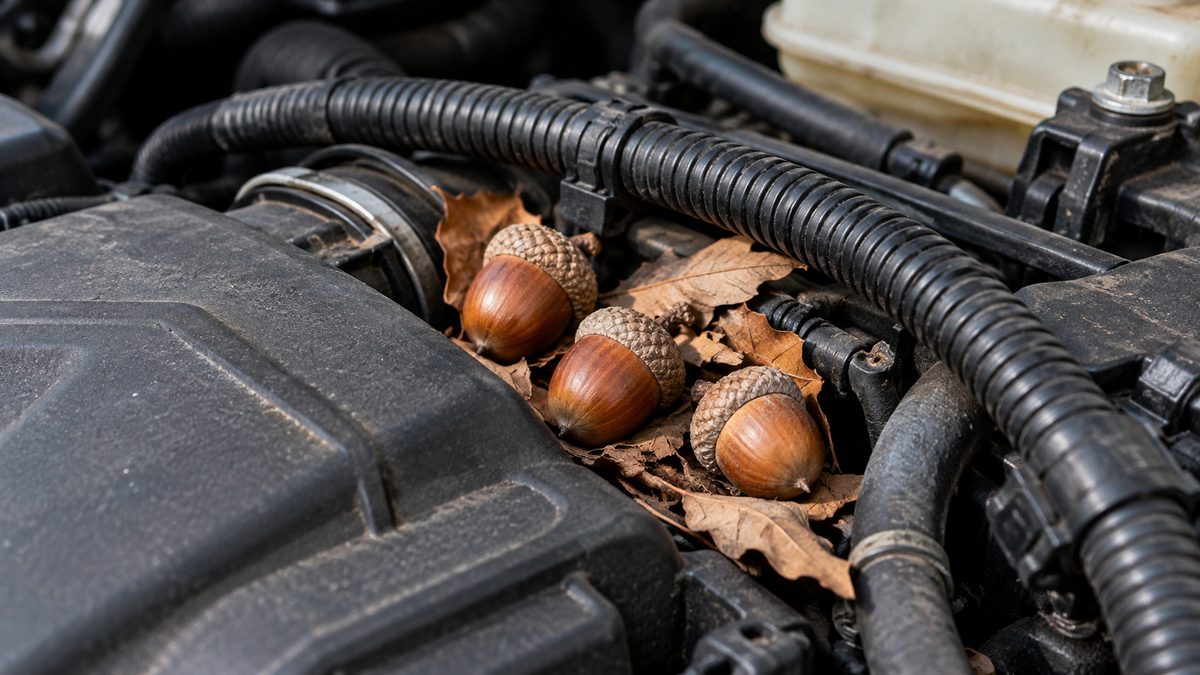
Nuts, shells and leaf material under the bonnet can indicate squirrel activity, but inspect for damage rather than identifying the animal from debris alone. Keep the engine off until any animal is clear and suspected wiring, hose or intake damage has been assessed.
Why squirrels pick cars
Squirrels spend autumn hiding food for winter. They bury nuts in lawns, tuck them into tree hollows and, when a car parks under the same tree every day, stuff them into the engine bay. It’s dry, sheltered and close to the food source. Cars parked under oak, walnut or beech trees, or near bird feeders, see this most.
Squirrels are rodents, so their front teeth grow continuously. They chew to keep them in check, and soft wire insulation, rubber hoses and foam insulation are easy work. Some owners also find leaf-and-twig nests in the engine bay of cars that sit unused.
Squirrel, rat or mouse?
| Sign | Squirrel | Rat or mouse |
|---|---|---|
| Active | Daytime | Mostly night |
| Food left behind | Whole nuts, acorns, walnut shells | Seed husks, pet food, droppings |
| Nest | Leaves and twigs | Shredded paper, cloth, insulation |
| Droppings | Fewer, larger, rounded | Many; small pellets |
If you’re finding droppings and shredded material rather than nuts, read mice in your car engine instead.
What to check after finding a stash
- The engine air filter box. Nuts and shells packed in here restrict airflow. Remove them and replace the filter if it’s damaged.
- The cowl area below the windshield, where the cabin air intake sits.
- Wiring and hoses near the stash. Look for bare copper, nicks in insulation and bitten vacuum lines.
- Hot spots. Clear nuts and leaves away from the exhaust manifold before driving; dry debris on hot metal is a fire risk.
- Warning lights. If any appear, have a mechanic check the wiring before longer drives.
How to stop squirrels using your car
- Change where you park. Moving the car out from under nut trees, even by a few metres, removes the reason to stash food there.
- Move bird feeders. Feeders draw squirrels in. Keep them well away from your driveway or garage.
- Trim overhanging branches so squirrels can’t drop straight onto the car or garage roof.
- Clear fallen nuts from the driveway in autumn.
- Use a garage and keep the door shut; squirrels rarely get into a sealed garage.
- Protect key wiring. Rodent-deterrent tape treated with capsaicin, the compound that makes chillies hot, is sold for wrapping exposed wiring. A mechanic can apply it to the runs that have been chewed.
Trapping rules
Start with removing accessible food sources, changing the parking location where practical and arranging a vehicle inspection. An occupied nest needs appropriate wildlife advice.
Squirrels, rats, mice and, in Europe, martens all chew car wiring for the same reason. Our guide to what rodents can chew through explains why no part of the engine bay is off the menu, and does car insurance cover rodent damage covers what to do about the bill.
Remove the reason to return without confronting wildlife
From a safe distance, note nearby nut trees, spilled birdseed and overhanging cover. Moving the car to a cleaner space can reduce access to a food-storage site. Clear fallen food around the parking area, but do not climb into a tree or disturb an occupied nest to protect the car.
If an animal remains in the bay, keep people and pets away. Do not start the engine, poke it with a stick or use smoke and chemicals to drive it out. Ask a local wildlife professional how to arrange removal, especially if young animals may be present.
Do not confuse debris removal with a repair
After safe removal, a mechanic may need to inspect the air intake, filter housing, visible cable runs and hoses. Ask for findings even if the engine still starts. A hidden nick or partially chewed connector can require attention before a warning light appears.
Let hot components cool and never reach beside belts or fans. Do not shake nuts deeper into the bay or wash them into inaccessible spaces. If covers must come off, have the workshop remove the material and check that the relevant openings and fasteners are restored correctly.
Check wildlife rules before buying a trap
Species and location affect what is permitted. Contact the relevant wildlife authority or an appropriately qualified professional for current advice before trapping or relocating any squirrel. A practice allowed elsewhere may not be suitable or lawful where you live.
For repeated visits, keep dated photographs of fresh material and review parking and bird feeding again. Do not assume a rat-and-mouse product has been shown to deter squirrels. Avoid improvising mesh across cooling openings or wrapping cables without workshop approval. Where waste is present, use official clean-up guidance and seek medical advice for a bite or illness after exposure. The goal is a safe vehicle and an appropriate wildlife response, with neither task replaced by an unverified repellent claim.
Frequently asked questions
Can a rat-and-mouse repellent be assumed to deter squirrels?
No. Do not extend a product’s species claims without supporting instructions and evidence. Focus on the parking site, vehicle inspection and appropriate wildlife advice.
Should I disturb a squirrel nest in a nearby tree?
Do not disturb an occupied nest to protect the car. Contact the relevant wildlife authority or a qualified professional about the species and local requirements.
Will moving fallen nuts beside another parked car help?
It only transfers the attraction. Clear accessible food appropriately and review feeding and storage around the whole parking area.
Can I keep driving if I only find nuts?
Have the intake and nearby wiring checked before assuming the deposit is harmless. Nuts may conceal damage or obstruct components even when there are no dashboard warnings.