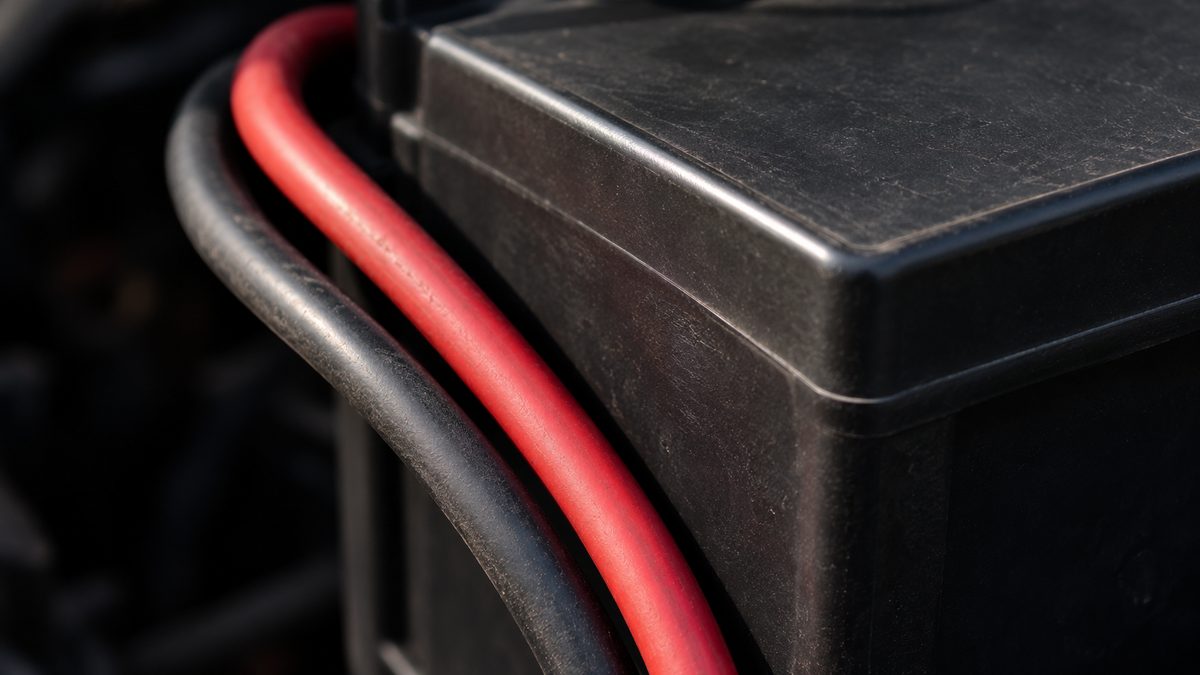
A car that spends weeks in a parking bay still uses electricity. Security systems, control modules and accessories may draw small amounts while it is locked. A battery cut-off switch interrupts the battery connection so isolated circuits cannot keep drawing power. That can help during storage, but the decision depends on which systems your car needs while parked.
What the switch changes
The switch opens the electrical path between the battery and the vehicle. It does not recharge the battery, repair a weak cell or remove the battery’s natural self-discharge. Anything connected outside the isolated path can continue drawing power. A qualified mechanic must check the whole installation, including aftermarket accessories, rather than assuming one switch disconnects everything.
Do not confuse a storage disconnect with a jump starter or a battery maintainer. Each does a different job. Before buying hardware, ask a workshop to test the battery and investigate unexplained rapid discharge. If the car goes flat overnight, isolation may hide a fault that will return as soon as normal use resumes.
Benefits during long parking
For a suitable vehicle, isolation reduces the slow drain from circuits that otherwise remain powered. A switch can be more convenient than repeatedly loosening a terminal, provided it is correctly specified and fitted. It may also create an extra obstacle to starting the car without permission. Treat that as a limited security benefit, with no promise that it prevents theft.
A healthy, fully charged battery is the starting point. Record the battery’s condition and follow the maker’s storage instructions. Plan periodic checks rather than leaving it untouched indefinitely. The time before a battery needs attention varies with its age, temperature, state of charge and remaining loads; no switch creates a fixed safe parking interval.
The trade-offs to check first
| Issue | Possible effect | Question for the workshop |
|---|---|---|
| Clock and radio | Lost time, presets or security-code request | What needs resetting after reconnection? |
| Control modules | Some settings or adaptations need relearning | Does this model require a specific procedure? |
| Alarm and tracker | Loss of supply or limited backup runtime | Which security functions will remain available? |
| Locks and access | Remote unlocking may stop working | Can I open the car safely with the mechanical key? |
| Warranty and insurance | Modification terms may apply | What written approval or notification is required? |
Modern cars differ widely. Ford’s owner information, for example, describes settings and adaptive functions affected by battery disconnection. That is a reminder to read your own model’s manual, rather than assuming the same relearning steps apply to every car. Save required codes and understand the reconnection procedure before storage begins.
Have a qualified mechanic fit it
The switch must suit the electrical system and starter current, with secure connections and appropriate protection. Poor contacts can heat up or cause intermittent starting. A mechanic should consider terminal layout, battery monitoring sensors and safe accessibility. Avoid improvised wiring, loose fittings or a small switch chosen only because its advertised voltage looks suitable.
Never operate a disconnect with the engine running. Use the vehicle’s shutdown procedure and allow the required time for electronics to shut down before isolation. This guide is not an installation procedure for hybrid or EV systems. Do not touch high-voltage components. Ask the manufacturer or an appropriately trained workshop about auxiliary-battery storage on those vehicles.
Consider a maintainer or regular driving
A compatible smart battery maintainer can preserve charge while leaving electronics connected. It needs a safe, permitted mains connection and the right settings for the battery type. Follow the vehicle’s approved charging points and the charger instructions. A shared basement bay with no authorised supply may make that option impractical; do not trail an unprotected extension lead across common areas.
Regular, useful drives can also help, depending on charging demand and trip length. A brief idle or repeated short starts may not replace the charge used to start the engine. Never idle in an enclosed garage. For a short absence, read what happens when a car sits parked for a week before deciding that a modification is necessary.
Keep rodent prevention independent
Disconnecting the battery does not stop rats entering the engine bay. Remove food nearby, inspect for fresh signs and arrange repairs for chewed wiring before restarting. EchoRepel’s car rat repellent can run on 4 × AA batteries, so in that mode it remains independent of the main battery connection. Check its batteries periodically and follow the mounting instructions.
Use that deterrent alongside clean parking and inspection, with no assumed unattended runtime. Our Diwali parking checklist brings together preparation for a longer trip. Choose the electrical storage plan with your workshop, confirm any insurance or warranty conditions, and leave a clear check routine for whoever will look after the parked car.