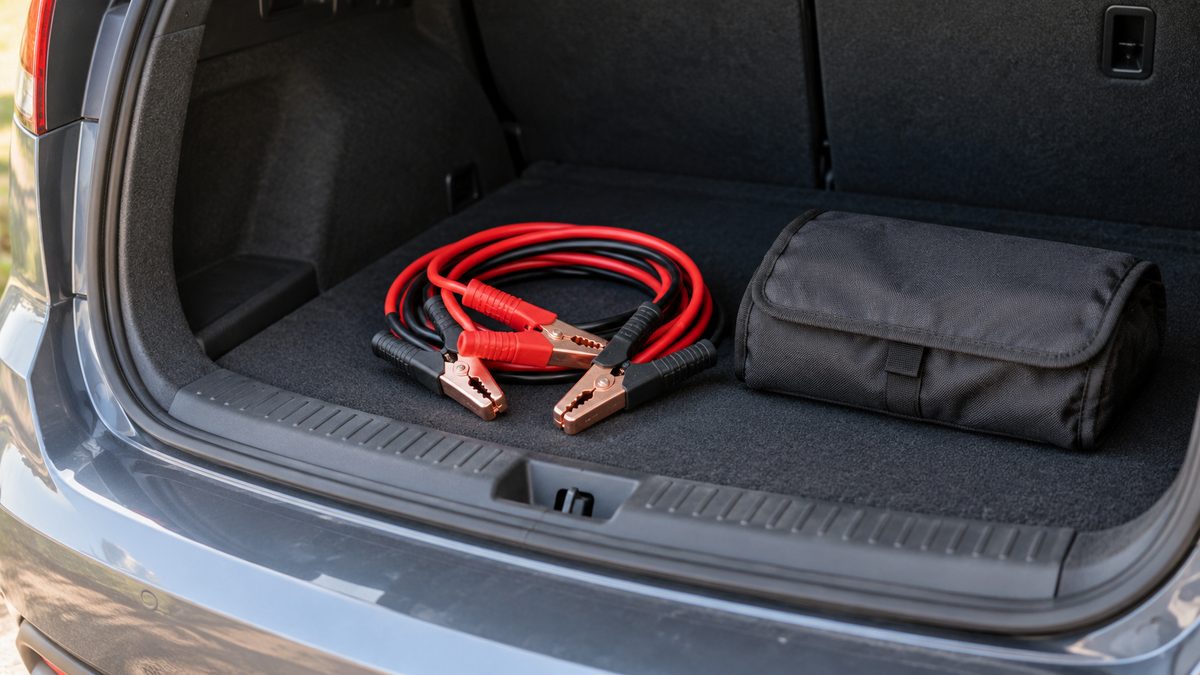
A portable jump starter is useful when you cannot count on another driver being nearby. Jumper cables are useful when a suitable donor vehicle is available and can park safely within reach. Neither choice removes the need to understand the connection points, inspect the battery and follow the relevant manuals.
For many drivers, the decision comes down to maintaining a charged pack versus relying on outside help. Before buying either, find the jump-start section in your owner’s manual. Some vehicles use remote terminals, restrict donor use or require a procedure that differs from a generic diagram.
How the two options supply starting power
A jump starter contains stored energy and cables intended to deliver a short burst of high current to a compatible vehicle. A phone power bank with a USB port does not provide that function unless it is also explicitly designed and rated as a vehicle jump starter.
Jumper cables store no energy. They create a temporary connection to another suitable battery or vehicle. Cable size, clamp quality, system voltage and the permitted donor procedure matter. Do not assume an electric or hybrid vehicle can act as a donor just because it has an auxiliary battery.
| Question | Portable jump starter | Jumper cables |
|---|---|---|
| Needs another vehicle? | No, if charged and compatible | Yes, or another approved starting source |
| Routine upkeep | Check charge, condition and storage limits | Inspect insulation, clamps and corrosion |
| Awkward parking | Can reach without aligning two cars | Donor must park safely within cable reach |
| Cold-weather planning | Check temperature limits and available charge | Donor battery and cables must suit the task |
| Repairs a failing battery? | No | No |
Connection order starts with the manuals
Stop if the battery is frozen, swollen, cracked, leaking or otherwise damaged. Do not jump it. Work away from traffic, flames and sparks; remove metal jewelry and use eye protection. Check voltage compatibility, set the parking brake and switch off accessories. Keep loose clothing and cables clear of fans and belts.
For a conventional negative-ground vehicle, a common cable sequence is red to the disabled vehicle’s designated positive point, red to the donor positive, black to donor negative, then black to the disabled vehicle’s designated ground away from its battery. Follow both owner manuals if their points or sequence differ. Never guess a ground connection.
The manuals also govern when engines should run, waiting periods, cranking attempts and disconnection. Remove connections in the specified reverse order, keeping clamps apart. There is no universal engine-running instruction for every vehicle. If the instructions conflict or the terminals are unclear, use roadside assistance.
A portable pack commonly connects positive first and then its negative clamp to the specified vehicle ground, with activation and removal controlled by the pack instructions. Follow its maximum cranking time and rest periods. Do not bypass an error warning or use a manual override unless you understand and meet the manufacturer’s requirements.
Read past the peak-amp headline
Peak amps describe a brief maximum claim. Cranking amps aim to describe starting output over a defined interval and conditions. Ratings and test methods vary, so two large numbers on different boxes may not provide a fair comparison. Look for documented compatibility with your engine size, gasoline or diesel engine, and electrical system.
Check clamp reach and grip at your actual jump points. Short leads can be awkward around a recessed positive terminal. Look for clearly described reverse-polarity, short-circuit and temperature protections, along with understandable indicators and a complete manual. Protection features reduce certain risks but cannot make an incorrect procedure safe.
A built-in air compressor may be convenient for tire maintenance, while USB charging can help keep a phone available. Treat those as extras after starting suitability. Check compressor duty limits and tire requirements. Using accessories consumes stored energy, so check the pack’s remaining charge before depending on it for a start.
Cold weather exposes weak batteries
Cold weather makes a marginal starting system less forgiving. The vehicle battery has less available performance while the engine can need more effort to crank. A portable pack also has temperature limits. Store and charge it as directed, inspect it before winter travel and recharge after use rather than leaving it depleted in the trunk.
During fall (autumn), arrange a battery check if cranking has slowed. Use our battery testing guide to understand preliminary checks and when a professional load test is useful. A voltage reading alone cannot show every battery or starter fault.
A successful jump is the start of diagnosis
Repeated jumps can point to a failing battery, inadequate charging, loose connections or an unwanted electrical drain. A jump starter supplies temporary help; it does not repair any of these faults. Review the signs a battery needs replacement and arrange tests rather than waiting for another breakdown.
A short drive after starting may not fully recharge a deeply discharged battery. Our home battery charging guide covers suitable charging and situations requiring help. Keep roadside assistance details accessible whichever tool you carry.
A car inverter serves a different purpose: it draws vehicle DC power to run compatible AC devices. The inverter EchoRepel sells does not start a car or recharge its starter battery. Choose starting equipment for starting, and plan any device charging around the vehicle’s socket limits and battery condition.