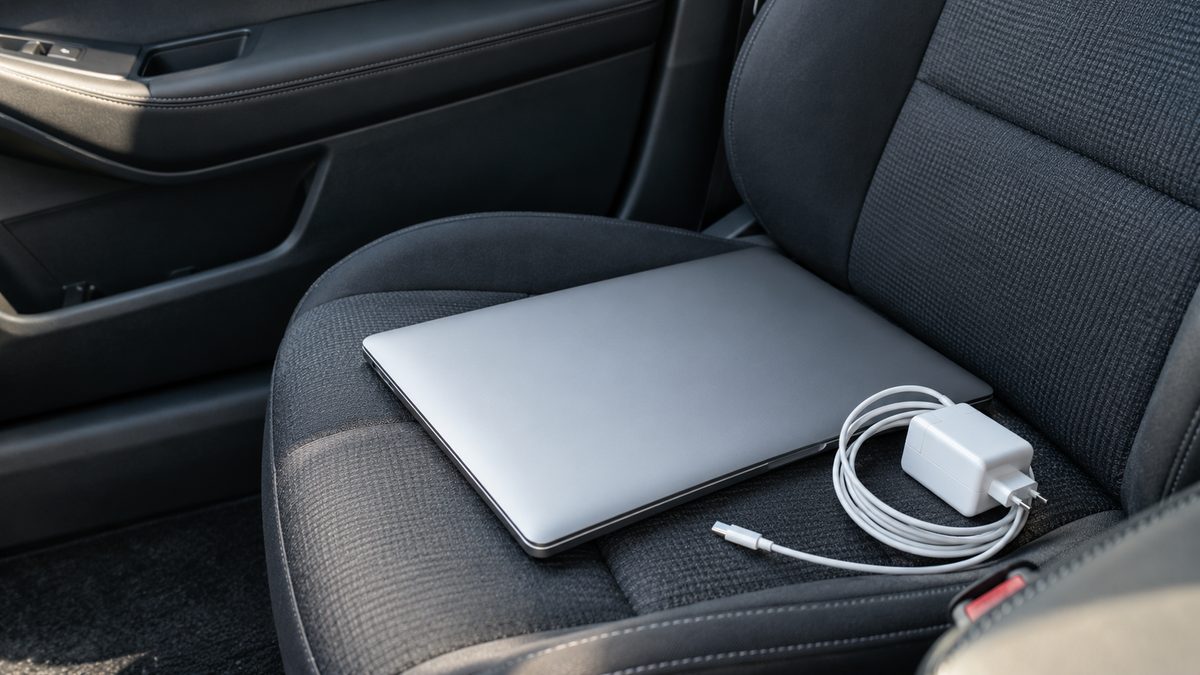
A laptop battery warning appears halfway through a road trip, and the only charger in your bag has a normal wall plug. The round accessory socket beside the gear lever cannot accept it directly. The device sold as a car charger to plug socket converter is usually a car inverter.
An inverter takes the car’s DC supply and creates AC for compatible chargers. A travel adaptor changes plug shape without converting power, so it cannot do this job. Before buying, check the vehicle socket, the inverter and the charger as one connected system.
Start with the charger label
Read the charger’s input voltage and frequency requirements, then compare them with the inverter’s AC output. A charger marked for a wide mains input range still needs a suitable power source. Do not assume that a socket accepting the plug proves everything else matches.
For planning, a laptop charger’s output rating gives a useful starting point, but its AC input can be higher because conversion wastes some energy. A 65W charger is a different load from a gaming laptop supply. Add every connected device and allow headroom rather than filling the inverter’s printed rating.
The car socket can be the smaller limit
Many accessory sockets are fused at around 10–15A. At a nominal 12V, multiplying voltage by current gives roughly 120–180W of DC input. Those figures are an illustration, not a universal permission to draw that much. Your manual may specify a lower wattage, a shared circuit or other restrictions.
AC output available through an inverter will be lower than its DC input because the inverter uses some energy. A 200W label therefore does not mean a 10A car socket can supply a 200W AC load. Follow the lower applicable limit and leave room for losses and changes in demand.
| Check | What it tells you |
|---|---|
| Vehicle manual and socket label | Permitted accessory load and any shared circuit limit |
| Inverter continuous rating | Maximum sustained output under its stated conditions |
| Charger input requirements | AC voltage, frequency and power compatibility |
| All connected devices | Total demand, including USB charging alongside AC |
Never fit a higher-rated fuse to make a larger load work. The fuse protects the vehicle circuit. For a worked approach to adding loads, read what size inverter you need before selecting a model.
Pure sine wave and modified sine wave
Pure sine wave output has a smooth waveform resembling household electricity. Modified sine wave output uses a stepped approximation. Some chargers accept it, while others may become noisy, run hotter or stop working. The charger manufacturer’s instructions matter more than a general compatibility claim.
For a laptop or camera charger with uncertain requirements, pure sine wave is the more cautious choice. It does not remove wattage limits or make a damaged charger safe. Our pure sine wave versus modified sine wave guide explains the distinction in more detail.
What belongs on a small car inverter
Compatible laptop, camera battery and phone chargers are reasonable candidates when their combined input stays within the available power. For a phone that accepts USB charging, a suitable direct USB port can avoid carrying its wall charger. Large laptops still need a separate wattage check.
Leave domestic heating appliances at home. A kettle commonly needs around 1,000–2,000W, and an iron often needs 1,000W or more. They exceed this setup by a wide margin. Our guide to kettles, hair dryers and irons on a car inverter covers those loads, including the limits of dedicated travel appliances.
Connect it for a journey
Park safely before arranging cables. Inspect the inverter plug and socket for looseness, debris or damage. Place the inverter on a stable, dry surface with its vents clear. Keep it off soft seats and out of a closed bag; route cables away from pedals, gear controls and passengers’ feet.
Follow the start-up order in the inverter instructions, then connect one charger before adding another. Stop if the plug becomes unusually hot, smells burnt or repeatedly cuts out. Do not improvise battery wiring to bypass a socket restriction. Ask the seller for help if the equipment behaves unexpectedly.
Finish by disconnecting
For longer use, keep the engine running only in a well-ventilated outdoor location where this is permitted. Never idle in enclosed society parking or a garage. Low-voltage protection is useful, but it cannot promise that an ageing battery will still start the car after extended accessory use.
EchoRepel’s 200W pure sine wave inverter provides two AC outlets, a 30W USB-C PD port and a QC3.0 USB-A port. All outputs count towards the combined load. Once charging is finished, switch off and unplug the inverter before leaving the parked car.