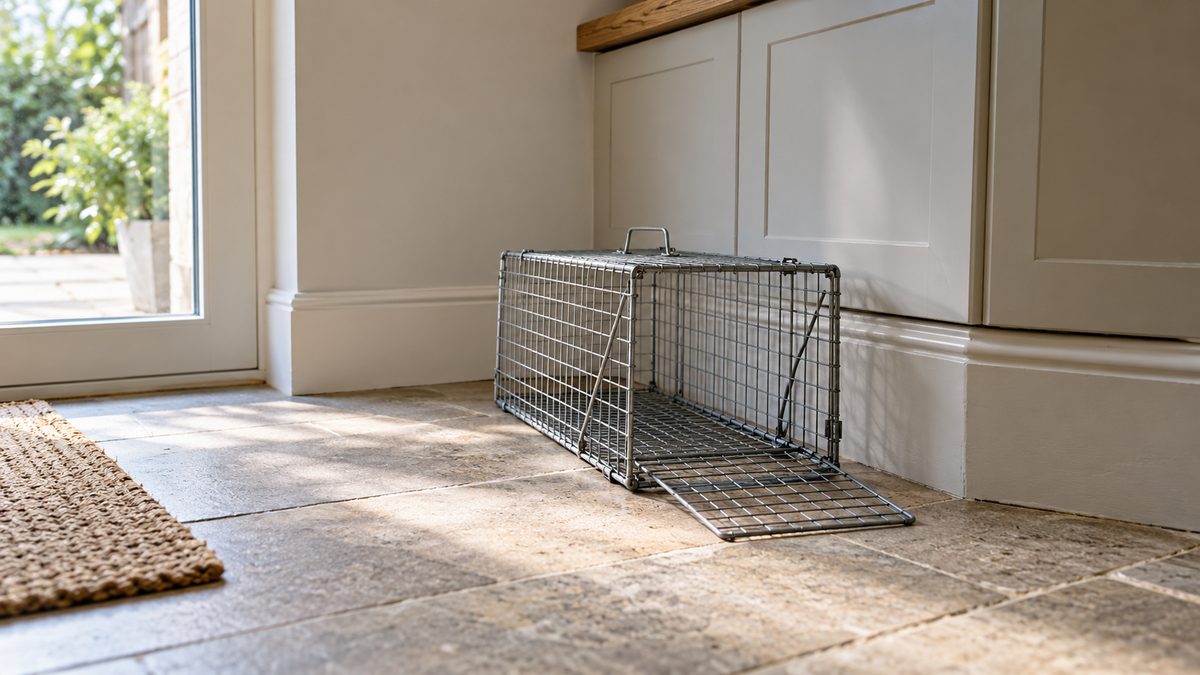
To catch a rat indoors without poison, put a suitable trap on its regular route and remove easier meals nearby. Chasing it with a broom often drives it behind a cupboard. Keep children and pets away from the room, close internal doors where practical and give yourself time to plan the capture.
Start with a torch and inspect floor edges for fresh droppings, gnawed packets or greasy marks. Do not reach blindly behind appliances. If signs cluster around stored cardboard or a loft, read our guide to finding a rat nest in your house before moving things.
Choose a trap you can monitor
A rat-sized snap trap is the usual practical option for household control. A mouse trap may injure a larger animal without killing it. Choose a sturdy mechanism, follow the manufacturer’s setting instructions and place it inside a suitable protective enclosure if children or pets could reach it.
| Trap | Useful feature | Main responsibility |
|---|---|---|
| Rat-sized snap trap | Quick mechanical capture when correctly set | Protect access and check daily |
| Cage or live trap | Captures the animal alive | Frequent checks and a lawful handling plan |
| Glue board | Restrains rather than promptly kills | Avoid because of prolonged suffering |
The Animal Welfare Board of India has advised against glue traps because they cause unnecessary pain and suffering. Do not treat a trapped animal as rubbish. If you find one stuck to a board, contact an animal-welfare organisation or trained professional for help.
Use a small amount of bait
Peanut butter sticks to a trigger, while coconut or a little roti with ghee may appeal to a rat already feeding in an Indian kitchen. These are bait options, not guaranteed favourites. Wear gloves when handling traps and avoid peanut products if anyone in the household has a relevant allergy.
Use a small dab or a firmly attached morsel rather than a loose pile. Too much bait gives the animal food without requiring contact with the trigger. Close grain sacks, wipe cooking spills and remove pet food overnight so the trap is not competing with an open buffet.
Place traps against the wall
Rats tend to travel along edges with cover nearby. Position a snap trap at a right angle to the wall, with its baited trigger end nearest the wall. Useful places include the route beside a storeroom shelf or the floor edge leading behind an appliance, provided the trap can be reached safely.
Do not place exposed traps in a walkway, on a food-preparation surface or where someone could step on them at night. Use several protected positions along confirmed routes when needed. A baited but unset snap trap can help a cautious rat approach before you arm it; keep it inaccessible throughout.
Write down each location. Check every trap at least daily and inspect live traps far more frequently. If bait disappears without a catch, review the attachment and trap size. Avoid repeatedly moving a well-positioned trap after one quiet night.
Have a plan for a live rat
A cage trap creates an immediate animal-handling problem. Before setting one, ask a local pest professional or animal-welfare service what lawful options are available. CDC household trapping guidance favours snap traps and discourages live traps because frightened animals can urinate and increase exposure during handling.
Never open the cage indoors, put fingers through the mesh or let a child carry it. Keep the animal out of direct sun and away from pets while seeking prompt help. Release far away only where local rules allow and a suitable, humane option has been confirmed. Relocation is no guarantee of survival.
Never drown, burn, starve or abandon a captured rat. If an animal is injured or still alive in a snap trap, keep your distance and call trained help rather than improvising. Gloves reduce contact with contamination but do not make a bite safe.
Clean the site and stop the next visit
For a dead rodent, wear rubber gloves, wet it and the surrounding contamination with a suitable disinfectant, and follow the label’s contact time. Double-bag the remains and used towels, follow local disposal instructions and wash gloved hands before removing gloves, then wash bare hands. Do not sweep droppings dry.
Poison can leave an animal dying inside a hidden void. Our article on why poison is a bad way to deal with rats explains the drawbacks. Trapping also needs follow-up: look for new signs, repair entry gaps and keep food in hard containers with tight lids.
Use the home rat-proofing checklist for door bottoms, plumbing gaps and storage. A continuous deterrent can be an additional layer in an open problem zone, but it cannot close a hole. Repeated catches, inaccessible nests or widespread contamination call for professional pest control.
For further handling guidance, see CDC advice on cleaning up after rodents.