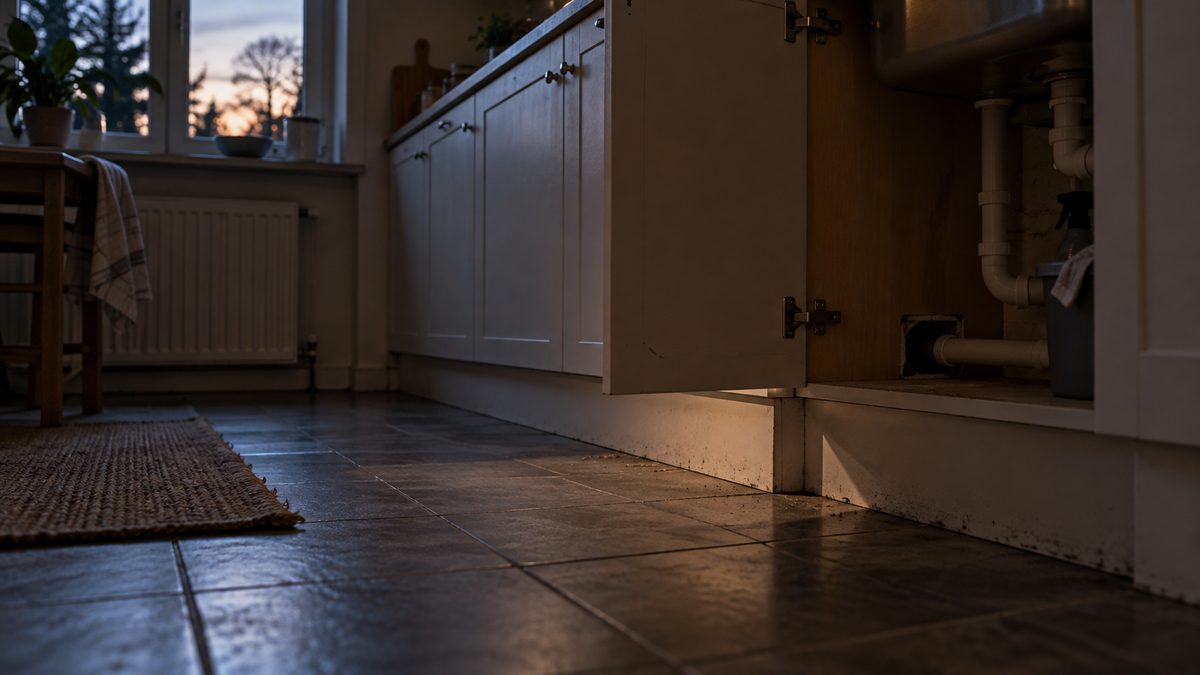
Rats can see in dim light, but they do not have sharp eyesight and cannot see in complete darkness. Their strong sense of smell, hearing and sensitive whiskers help them move around when there is little light. For a homeowner, checking the route they use is more useful than leaving a lamp on.
Limited eyesight does not leave a rat lost at night
A dark kitchen still contains information that a rat can use. Food has a smell, appliances make sounds and nearby surfaces provide contact for its whiskers. Vision is one part of that picture. Poor eyesight does not prevent a rat finding a sheltered route beside a cupboard or wall.
Think of the space behind your cooker. You may need a torch to examine it, yet a rat does not need to read labels or make out fine detail to move through it. This is why changing the lighting alone leaves the route, shelter and food in place.
Do not assume a rat cannot detect you because you are standing still in a dim room. Movement, sounds and scent can all alert it. Watching quietly from a distance is safer than stepping into its path to see how well it reacts.
Why the kitchen goes quiet before the scratching starts
Rats often move when a home is quieter and people are less active. Darkness and reduced disturbance commonly arrive together, so hearing scratching after bedtime does not prove that light was keeping them away earlier. Access to food and cover still matters.
Sounds can also come from pipes, building movement or other animals. Note the room, approximate time and type of noise rather than naming the animal from sound alone. Our article on scratching in walls at night explains the next checks.
A sighting during daylight does not, by itself, establish how many rats are present or whether an animal is ill. A disturbed hiding place or available food may change when it appears. Read about rats coming out during the day before drawing conclusions from the clock.
Follow the edges when looking for evidence
Start with places where a sheltered route meets something useful, such as a bin cupboard, pet feeding area or pipe opening. Use a torch from a safe standing position. Do not reach behind an appliance you cannot see or move heavy equipment alone.
| Place to examine | Clues to record | Useful next action |
|---|---|---|
| Along skirting boards | Droppings, gnaw marks or repeated movement | Photograph the location without touching waste |
| Under the sink | Openings beside pipes and damaged packaging | Arrange suitable repairs after checking for active rodents |
| Behind food storage | Torn packets and spilled dry food | Discard contaminated food and protect the remaining stock |
| At an external doorway | Damaged seals or a visible gap | Inspect the threshold and fit an appropriate repair |
One mark is rarely enough to explain the whole problem. Take photos before cleaning, then keep a dated note of further signs. This gives a pest professional something more useful than a single hurried glimpse in a dark room.
What to do when the torch catches a rat
Stop moving towards it. Keep children and pets away and leave the animal room to move without passing close to anyone. Do not poke it out from under furniture, try to pick it up or send a pet after it.
If it disappears into a gap, mark the location in your notes. Do not immediately block that opening while an animal may remain in the room or building cavity. A pest professional can plan removal and repairs together. Our guide on seeing a rat in your house covers the immediate response.
Avoid sweeping or vacuuming droppings, which can put contaminated dust into the air. Follow your local public health authority's rodent clean-up guidance before handling waste. Large deposits, inaccessible nests or contamination around electrical equipment call for professional help.
Replace the night-light plan with an entry-point check
Leaving lights on does not repair a door seal or remove a food source. Begin with accessible food: clear crumbs, store dry goods in sound containers and avoid leaving pet food out after feeding. Use a bin with a lid that closes properly and clear spills beneath it.
Next, examine external doors, service openings and damaged vents. Keep ventilation and drainage working when arranging repairs. Do not stuff random material into an opening whose purpose you do not understand. For a more detailed inspection route, use our house rat-proofing checklist.
Clear clutter that prevents you seeing the base of cupboards and walls. This makes future checks easier and removes some sheltered hiding places. After cleaning and repairs, monitor the same locations rather than relying on a quiet night as proof that the problem has ended.
The EchoRepel Ultrasonic Rat Repellent uses ultrasonic sound that rats and mice want to avoid and is poison-free. It does not replace finding entry points, removing food access or getting help with an active infestation.