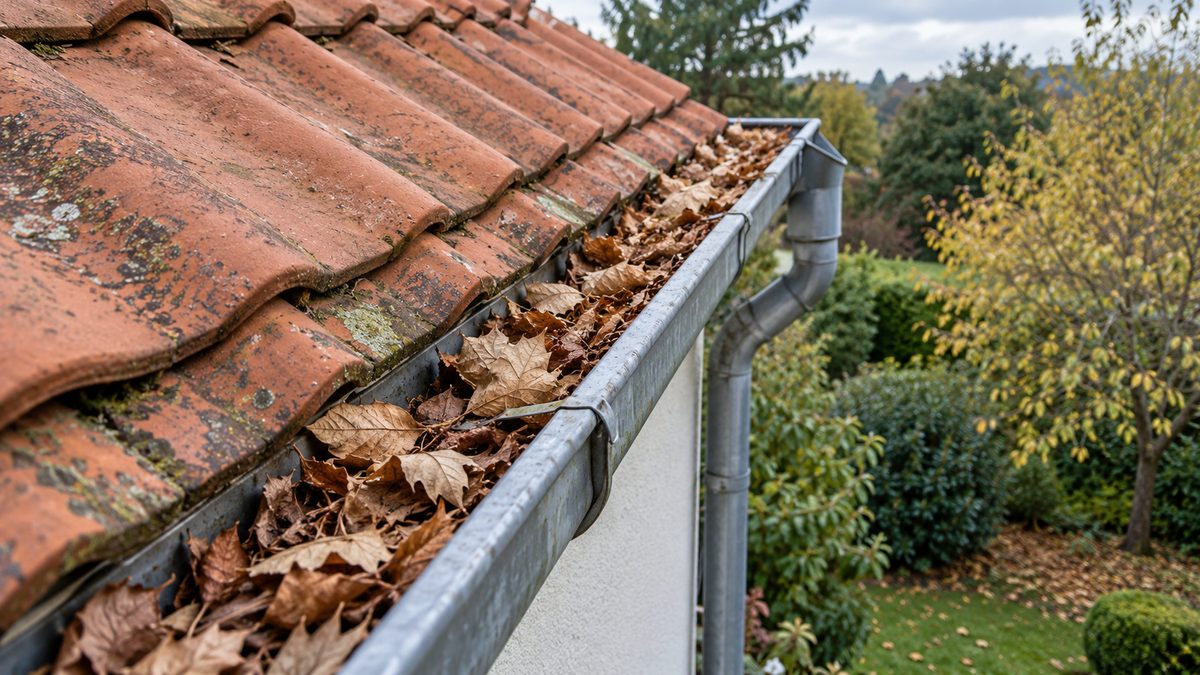
Most rat-proofing focuses on doors, drains and low gaps. Rats are also strong climbers, and in autumn, when gutters fill with leaves and lofts are warmer than outside, they often come in from above. If you hear scratching overhead at night but find no gaps at ground level, look up.
How rats reach the roof
- Drainpipes, especially where they run close to a rough wall.
- Overhanging branches that touch or come close to the roof.
- Climbing plants such as ivy growing up the walls.
- Cables and wires running to the house.
- Neighbouring roofs on terraced or semi-detached houses.
Our guide on whether rats can climb walls explains how they manage vertical surfaces.
Why gutters matter in autumn
Leaf-filled gutters hold water and debris, may collect seeds, and form a sheltered runway along the roof edge. They lead straight to the eaves, where gaps between the wall, fascia board and roof tiles often open into the loft. Clearing gutters in autumn removes the runway and lets you see the roof edge clearly.
Signs rats are using the roof
| Where | Sign |
|---|---|
| Loft or false ceiling | Scratching at night, droppings, chewed insulation or boxes |
| Gutters | Droppings or debris pulled into piles |
| Eaves and fascia | Gnaw marks, greasy dark smears around gaps |
| Walls and drainpipes | Rub marks where rats climb repeatedly |
| Upper rooms | Noises in ceilings and the tops of walls |
Our guides to rats in the loft and rats in the false ceiling cover what to do once they are inside.
How to block routes from above
- Cut back branches so they are well clear of the roof.
- Trim climbing plants away from eaves, windows and gutters.
- Clear gutters of leaves and debris, and fit gutter guards if leaves are a constant problem.
- Fit drainpipe guards, metal collars or cones that stop rats climbing pipes.
- Seal gaps at the eaves with metal mesh or proper eaves fillers, keeping roof ventilation open.
- Repair broken or slipped tiles and damaged fascia boards.
- Check vent pipes and roof vents have intact mesh covers.
Remember how small an entry point can be. Our guide on gap sizes explains what to look for.
Stay safe working at height
Gutter clearing and roof repairs involve ladders and heights. Use a stable ladder on firm ground, have someone hold it, and do not lean out to one side. Never climb onto a roof in wet, icy or windy weather. For anything beyond what you can reach safely from a ladder, hire a roofer or gutter cleaner.
An autumn roof-edge checklist
Autumn is the right time to look, because leaves are falling and rodents are looking for warm shelter. Work through this list from the ground first, using binoculars if your roof is high, and only use a ladder where it is safe:
- Are gutters sagging, overflowing or full of leaves and moss?
- Do any branches touch the roof or come within easy jumping distance of it?
- Is ivy or another climber growing up to the eaves or around downpipes?
- Are there gaps where the roof meets the wall, or where fascia boards have rotted or come loose?
- Are any tiles cracked, slipped or missing, especially at the ridge and roof edges?
- Do roof vents, soil pipes and extractor outlets still have their mesh or covers?
- Inside the loft, can you see daylight anywhere it should not be?
Anything you find on this list is worth fixing before winter, whether or not you have seen rats yet. Repairs to roofs and fascias are best done by a roofer, who can also check that sealing the gaps does not block the ventilation the roof needs to stay dry.
In short
If you hear rats overhead, check the roof route. Cut back branches and plants, clear gutters, guard drainpipes and seal gaps at the eaves with metal mesh while keeping ventilation open. Work safely at height or use a professional.
Once the roof gaps are sealed, the EchoRepel Ultrasonic Rat Repellent adds a poison-free layer for lofts and upper rooms, using ultrasonic sound that rats and mice want to avoid.