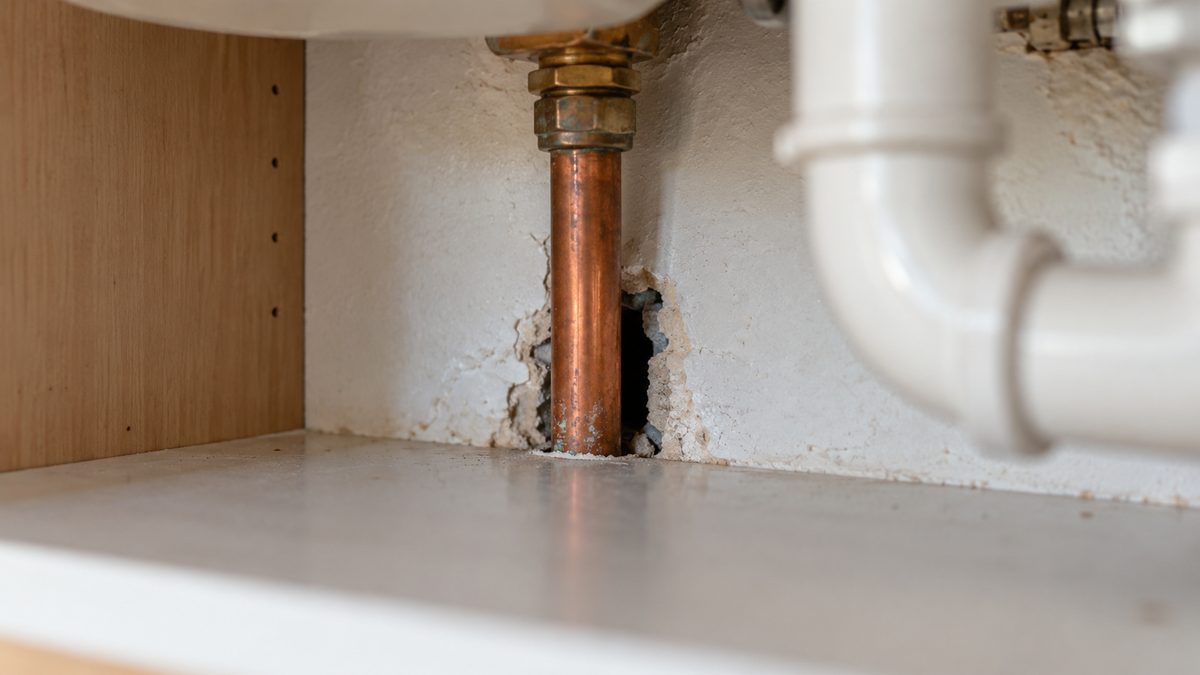
Most people look for a hole the size of a mouse. That is why mice get in. A young mouse can squeeze through a gap roughly the width of a pencil, and a young rat through one roughly the width of a thumb. Their skulls are the widest rigid part of the body, so if the head fits, the rest usually follows. Knowing the size to look for changes where you check and what you use to seal.
Gap sizes at a glance
| Animal | Approximate gap | Everyday comparison |
|---|---|---|
| Young mouse | About 6 to 7 mm | The width of a pencil |
| Young rat | About 12 to 15 mm | The width of your thumb |
| Adult rat | A little more, and they gnaw gaps wider | A small coin on edge |
These are rough guides rather than exact limits. Treat any gap you can push a pencil into as a possible entry point.
Where these gaps hide
- Where pipes and cables enter: under sinks, behind washing machines and cookers, and where new cables were added.
- Under external doors: worn thresholds and garage doors that do not close to the floor.
- Air bricks and vents: damaged covers or missing mesh.
- Around window and door frames: where sealant has cracked or shrunk.
- Roof and eaves: gaps under tiles, at fascia boards and around gutters. See rats in gutters and roofs.
- Drains: damaged pipes and loose covers. Our guide on rats and drains explains this route.
- Kitchen units: open backs and loose kickboards that connect to wall gaps.
How to inspect properly
- Work from outside first, walking the whole wall line at ground level with a torch.
- Look for greasy rub marks, droppings and gnawing near gaps; these show which ones are in use.
- Inside, empty the cupboard under the sink and look behind appliances.
- Use a pencil as a gauge: if it slides in, the gap needs sealing.
- Check the loft or false ceiling for droppings and daylight showing through.
What to seal gaps with
| Material | Use it for | Notes |
|---|---|---|
| Steel wool or copper mesh plus sealant | Small gaps around pipes and cables | Pack firmly, then cover so it stays in place |
| Fine metal mesh | Air bricks, vents, weep holes | Keeps airflow; never block ventilation completely |
| Mortar or cement | Holes in brick or block walls | Long-lasting for larger gaps |
| Brush strips, door sweeps, metal kick plates | Gaps under doors | Check they touch the floor along the full width |
| Expanding foam | Filler only, behind mesh | Rodents can chew through foam on its own |
Gas pipes, electrical intakes and anything near a boiler flue should be sealed by a qualified tradesperson. Our room-by-room guide to rat-proofing your house covers more detail.
Recheck after building work and seasons
Sealing is not a one-off job. New gaps appear when a plumber adds a pipe, a cable installer drills through a wall, or a door threshold wears down. Sealant shrinks and cracks over time, and mesh can rust or be pushed aside. Walk the outside of the house again each autumn, before rodents start looking for warm shelter, and after any building or repair work. Check the same places each time, and keep a note of what you sealed and where so you can spot anything new quickly.
Do not trap rodents inside
If rodents are already living indoors, sealing every gap at once can trap them inside, where they may cause more damage or die in a wall cavity. Deal with the ones inside first, or seal in stages and leave the main route until last, and get professional help for a large problem. Our guide to whether rats come back explains why sealing matters after removal.
In short
Assume any gap a pencil can enter is big enough for a mouse, and any gap your thumb fits is big enough for a young rat. Inspect pipe and cable entries, doors, vents, roofs and drains, and seal with metal and mortar rather than foam alone, keeping vents open with mesh.
Once the gaps are sealed, the EchoRepel Ultrasonic Rat Repellent adds a poison-free layer in rooms rodents were using, with ultrasonic sound that rats and mice want to avoid.