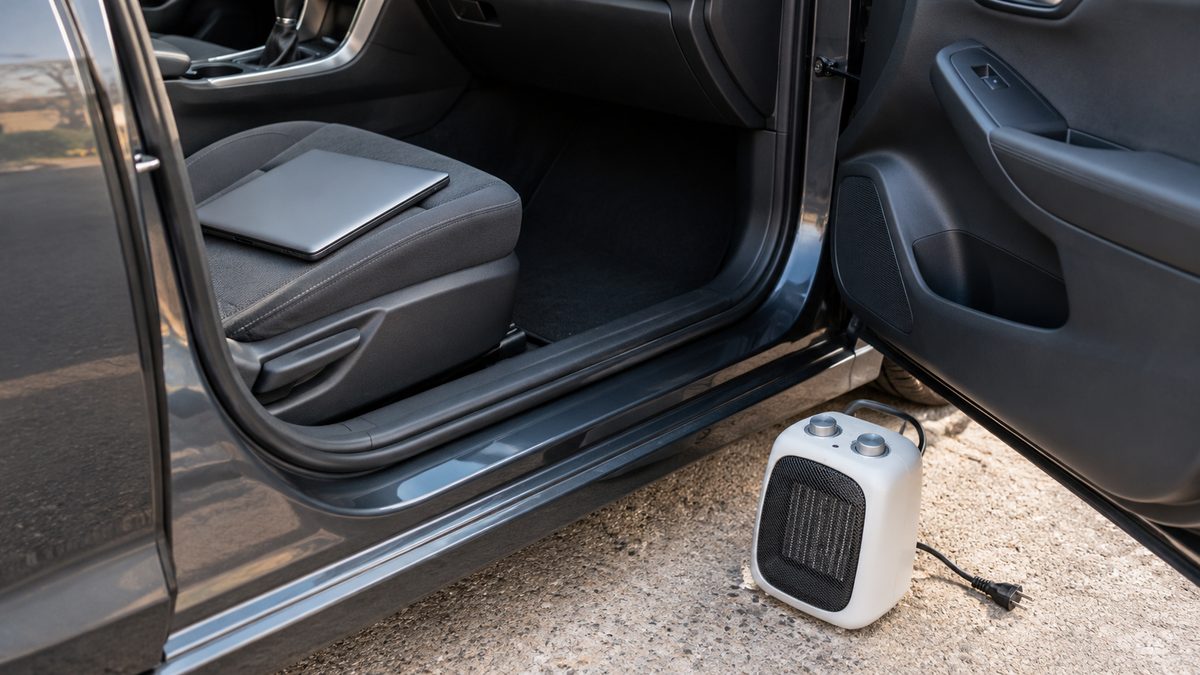
A household space heater cannot run from a typical car-socket inverter. The heater needs much more power than the socket and inverter can supply. A small casing, low thermostat setting or spare AC outlet does not change that limit. Do not plug it in to see whether the protection trips.
Space heaters typically draw around 750 to 1,500 watts; check the label on the exact appliance. A 200W inverter is intended for much smaller compatible loads. Winter warmth needs a separate plan built around clothing, blankets, safe vehicle use and access to help if conditions deteriorate.
The socket limit comes before the AC outlet
A 12V accessory socket is usually fused around 10 to 15 amps. Multiplying voltage by current gives roughly 120 to 180 watts of input power. Check the vehicle manual because socket ratings and shared circuits vary. Some of that input is lost during conversion, so available AC output is lower.
The lower limit governs: the vehicle socket or the inverter rating. A 200W label cannot make a 120W socket supply 200W. Our cigarette lighter inverter guide explains why a socket connector places a practical restriction on the whole setup.
| Load or supply | Typical power | Meaning for a car socket |
|---|---|---|
| 12V socket at 10 amps | Roughly 120W input | AC output is lower after losses |
| 12V socket at 15 amps | Roughly 180W input | Check manual and shared loads |
| Small car inverter | 200W rated maximum | Cannot override the socket limit |
| Space heater | Typically around 750 to 1,500W | Too much for this setup |
| 12V heated blanket | Model-dependent; check the label | Only use if rated for the socket |
Why the heater’s low setting does not solve it
Even a typical 750W setting needs several times the power available through an ordinary car socket. At 12V, supplying 750W would require roughly 62.5 amps before inverter losses. A 1,500W heater would require roughly 125 amps before losses. These are illustrative demands, not instructions for building a battery connection.
A thermostat switches the heating element on and off as needed. While the element is on, it still draws its rated heating power. Turning the temperature dial down does not turn a household heater into a small USB accessory. Read the electrical label and manual rather than relying on the word mini.
Never install a larger fuse, bypass protection or improvise wiring to force the appliance to work. An overloaded connection can overheat. If a plug, socket or inverter becomes hot, smells burnt or shows damage, stop using it and have the fault checked. Repeatedly resetting a shutdown is not a repair.
A larger inverter is a different installation
A high-capacity battery-connected system requires correctly designed cabling, fusing, battery capacity and charging support. Buying a larger inverter alone does not provide those things. That is outside what a small socket-powered accessory can do, and a vehicle electrical specialist should assess any proposed permanent installation.
Other heat appliances create the same problem. See why a small car inverter cannot run a kettle, hair dryer or iron. Do not use a heater as a test load or assume that two AC outlets mean twice the power. All connected devices share the inverter’s available capacity.
Use clothing and blankets first
Plan for each passenger rather than one shared source of heat. Keep spare layers dry and check that children can reach their blankets. A charged phone and a separate flashlight also help you arrange assistance without spending the starter battery on unnecessary accessories. Review the kit before travel instead of discovering missing supplies during a delay.
Pack warm layers, a hat, gloves and dry socks where passengers can reach them. Blankets help retain body warmth without drawing power from the starter battery. Prepare during fall (autumn), then check supplies before long winter journeys. Wet clothing and a blanket buried beneath luggage make a delay harder to manage.
A purpose-made 12V heated blanket is a possible supplementary option only when its rating suits the socket and the manufacturer permits the intended use. Check voltage, watts or amps, and other loads on that circuit. Follow time limits and operating instructions, keep cables intact and avoid extended use with the engine off.
Use the engine only in safe outdoor conditions
If you use the vehicle’s built-in heating, run the engine only outdoors with the exhaust clear of snow and debris. Never run it in a garage or another enclosed space, even with the door open. Keep exhaust away from building openings and do not leave a running vehicle unattended.
In a breakdown, contact roadside assistance and follow local emergency guidance for your location. If conditions make staying warm difficult, seek help early rather than relying on prolonged idling. Snow can build up again around an exhaust, so an initially clear tailpipe does not remove the need for further checks.
Never use a portable fuel heater, camping stove or charcoal inside a vehicle. A generator also belongs outdoors, away from doors, windows and vents, never in a garage. Our generator and power inverter comparison explains their different roles. Neither a socket inverter nor a combustion appliance inside the cabin is a substitute for a safe winter plan.