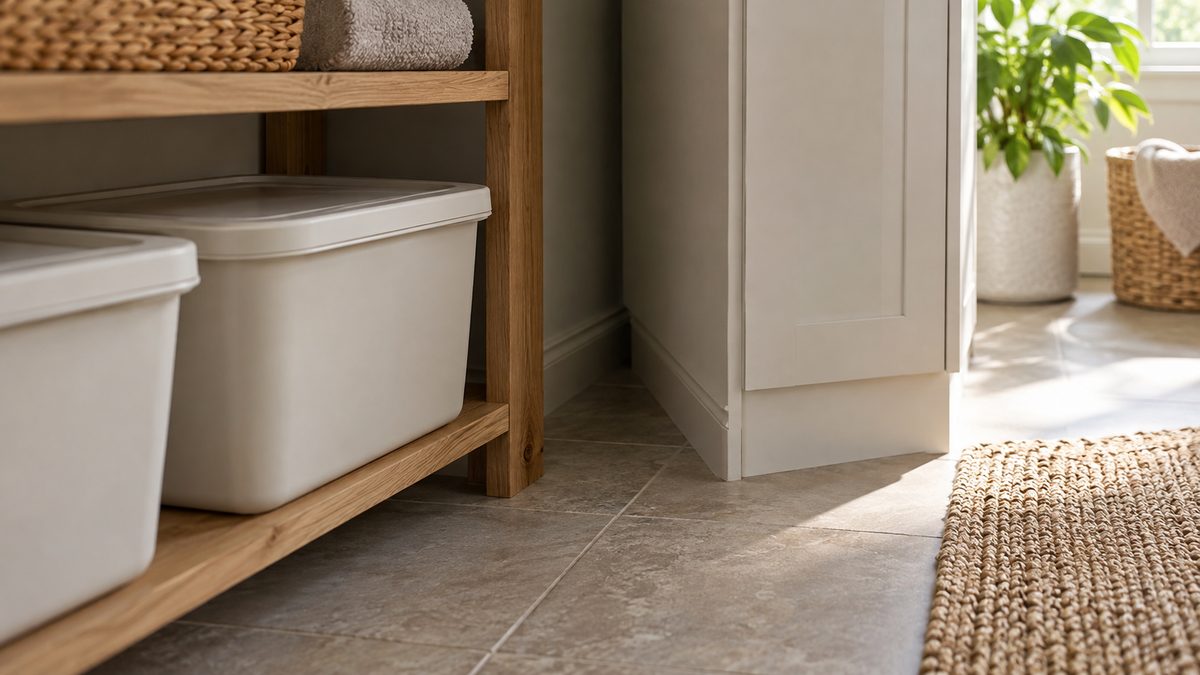
Rats can hide in appliance gaps, furniture bases, cabinet voids, lofts and garages, not just behind walls. Search accessible places for connected evidence, and leave dangerous or contaminated voids to the appropriate professional.
1. Behind and under the fridge
The motor keeps it warm, and nobody moves it for months. Prime real estate.
2. Inside the sofa or armchair
The hollow base of upholstered furniture is soft, dark and rarely disturbed, an ideal nest.
3. The false ceiling
A whole hidden floor of warm, quiet space with easy runs along the beams.
4. Behind the washing machine
Warmth, a nearby water supply, and a gap to the wall, three draws in one spot.
5. Storerooms and lofts
Boxes, old clothes and clutter give rats both shelter and nesting material.
6. Inside kitchen cabinets and their kickboards
The sealed space beneath base cabinets is a favourite highway and nesting spot.
7. Wall voids around pipes
Wherever a pipe enters a wall, there is usually a gap, and a gap of 2 cm is a doorway.
8. The garage or car parked inside it
Quiet, sheltered and often cluttered; from here they move into a car's engine bay too.
9. Behind large appliances and electronics
TVs, servers and set-top boxes give off warmth and sit undisturbed against the wall.
A 15-minute inspection route
Take a torch, gloves and your phone, and check each spot in order. Look for these signs at each one:
| Spot | What gives it away |
|---|---|
| Behind the fridge | Droppings on the floor, chewed insulation on the back panel, a musky smell |
| Sofa and armchair bases | Torn lining underneath, stuffing pulled out, droppings around the legs |
| False ceiling | Scratching at night, droppings near light fittings, stains on the boards |
| Washing machine | Chewed inlet or drain hose, droppings behind it |
| Storeroom / loft | Shredded paper or cloth, gnawed carton corners |
| Kitchen cabinet bases | Droppings on the cabinet floor, gnawed kickboard edges |
| Pipe entries | Greasy dark rub marks around the hole, widened gaps |
| Garage / parked car | Droppings on the engine cover, leaves or paper in the bay |
| Behind the TV and router | Chewed cables, droppings behind the unit |
When are they most likely to move in?
- Monsoon: flooded drains and burrows push rats upwards and indoors. In Mumbai and the coastal cities, this is peak season.
- The first cool nights: warmth becomes the draw. See why rats move indoors when the weather turns cold.
- Renovation and construction nearby: digging and demolition disturb existing colonies, which then look for new homes.
Why these spots, every time
Every hiding place on this list offers the same things: warmth, darkness, silence and something soft to nest in, close to food and water. Once you start looking at your home the way a rat does, which corners nobody touches for months?, the likely spots become obvious. The fix is to take away that quiet: move furniture, clear clutter and clean the places nobody cleans.
How to reclaim the space
For surprising places rats hide in your home, the EchoRepel Home Rat Repellent is a supporting option using ultrasonic sound that rats and mice want to avoid. It is poison-free. For surprising places rats hide in your home, use the device only as instructed and assess new signs rather than assuming protection.
Choose a safe order for the room search
Begin at floor level with a torch, looking along edges and behind objects that can be moved safely. Check lower shelves and the accessible outside of furniture before lifting anything. If a sofa base appears occupied, keep children and pets away and ask for removal advice rather than turning it over abruptly.
Do not pull a heavy appliance by its door, hose or power lead. Moving a cooker can affect gas or electrical connections, while a washing machine can strain its plumbing. Ask maintenance staff or a suitable technician for access where necessary.
What to record at each hiding place
Note the exact position of gnawing, waste and shredded material, and photograph without touching. A single sign can have several explanations; a cluster that returns after safe cleaning gives a clearer reason for pest inspection. Keep noise observations separate because sound can travel through cavities.
Do not spread powder into an occupied void or disturb pellets to test freshness. Follow official rodent-clean-up guidance for accessible waste. Extensive contamination, hidden nests and electrical damage are reasons to stop the household search and bring in professionals.
Reclaim storage without making the next check harder
Once removal and cleaning are complete, keep suitable belongings in closed containers and leave access to the wall edges. Avoid stacking boxes tightly around pipe entries or electrical equipment. Label stored items so you can find them without repeatedly emptying the whole room.
Repairs should close the actual entry route while preserving ventilation and service access. A cupboard tidied today may still connect to an open wall cavity, and a garage may keep supplying visitors to the house. Ask a pest professional about removal and sealing in the correct order. If a bite occurs or anyone feels unwell after contact with rodent material, seek medical advice. A quieter room after decluttering is encouraging, but use follow-up evidence to decide whether the underlying problem has been resolved.
For surprising places rats hide in your home, related questions include how to find a rat nest in your house, how to rat proof your house.
Frequently asked questions
Should I pull a cooker out to inspect behind it?
Do not move a gas or heavy electrical appliance without suitable help. Connections can be strained, and the inspection should not create a new service hazard.
Is the loudest corner always the hiding place?
No. Cavities and pipe runs can carry sound. Record the noise separately from visible evidence so a professional can assess both.
How should I move a contaminated storage box?
Avoid carrying dusty material through clean rooms or shaking it out. Follow official rodent-clean-up advice and seek professional handling for extensive contamination.
Should I check a room that has no food in it?
Yes. A quiet storage or sleeping area can be used for shelter while rodents feed elsewhere. Look for routes connecting it to kitchens, utility spaces or the outside.