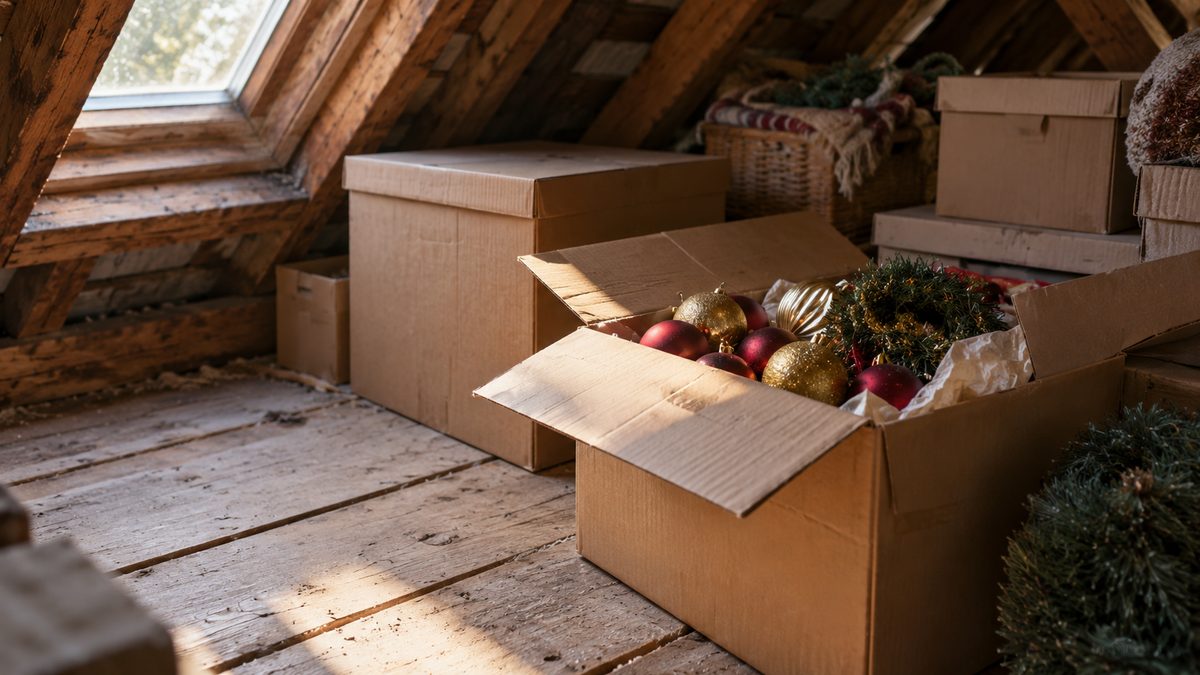
Decoration boxes spend most of the year somewhere quiet, dark and undisturbed: the loft, the garage, a storage room or under the stairs. That is exactly the kind of place mice look for as the weather cools. Cardboard, tissue paper and fabric make good nesting material, so it is worth checking boxes before you carry them through the house.
Open the boxes in the right place
Bring boxes down to the garage, a balcony or outside if you can, rather than opening them on the living room floor. If a mouse is still inside, it will run, and you would rather it ran outdoors. Lift boxes slowly and look underneath them first. Chewed corners or droppings on the outside are a sign to open that box with care.
Signs mice have been in your decorations
- Droppings: small, dark and pellet-shaped, often in corners and along box seams.
- Shredded material: tissue paper, tinsel or fabric pulled into a soft ball, which is often a nest.
- Gnaw marks: chewed cardboard edges, foam, plastic ornaments or wreath bases.
- Chewed wires: nicks or bare copper on light strings and plug-in decorations.
- Smell: a sharp, musty odour of urine when you open the lid.
Not sure whether it was mice or rats? Size of droppings and damage helps. Our guide to telling rats and mice apart explains what to look for.
Check every light string before plugging it in
Rodents gnaw constantly, and wire insulation is an easy target. A light string with a chewed section can short or overheat once it is plugged in. Run each string slowly through your hands in good light, checking the whole length, the plug and the joints between bulbs. If you find any damage, throw that string away. Do not tape over it and do not plug it in to test it.
Clean up safely
Mouse droppings and urine can carry germs, so avoid stirring up dust:
- Open a door or window and let the space air out for a while.
- Wear disposable or rubber gloves.
- Do not sweep or vacuum droppings while dry.
- Spray droppings and nesting material with disinfectant and leave it to soak, following the product label.
- Wipe everything up with paper towels and seal it in a bag for the bin.
- Clean hard ornaments with disinfectant, then wash your hands well.
Fabric items, tree skirts and stockings that have been soiled can go through a hot wash if the label allows; badly soiled soft items are best thrown away. Our guide to cleaning mouse droppings covers the full method.
Store them better this year
| Instead of | Use |
|---|---|
| Cardboard boxes | Hard plastic boxes with tight-fitting lids |
| Tissue paper and newspaper wrapping | Bubble wrap or ornament dividers |
| Boxes on the floor against a wall | Boxes on shelves, away from walls |
| Edible ornaments and scented candles packed in | Food and scented items stored separately or thrown away |
Mice in the boxes often means mice nearby
If you found droppings or a nest, the mice came from somewhere and may still be around. Check the rest of the loft or garage for droppings, gnawed insulation and gaps around pipes, cables and vents. Our guides to rodents in the loft and mice in the garage explain how to find entry points and seal them. Autumn is when many mice move indoors, as our article on why mice come inside in autumn explains.
If you see signs across several rooms, hear scratching most nights or find chewed wiring in the walls, call a professional pest controller.
In short
Open stored decorations outside or in the garage, look for droppings, nests and chewed wires, and never plug in damaged lights. Clean droppings wet, not dry. Then repack in sealed plastic boxes off the floor, and check where the mice came in.
For lofts, garages and storage rooms, the EchoRepel Ultrasonic Rat Repellent fills the space with ultrasonic sound that rats and mice want to avoid, poison-free and safe to leave running while the boxes sit in storage.